
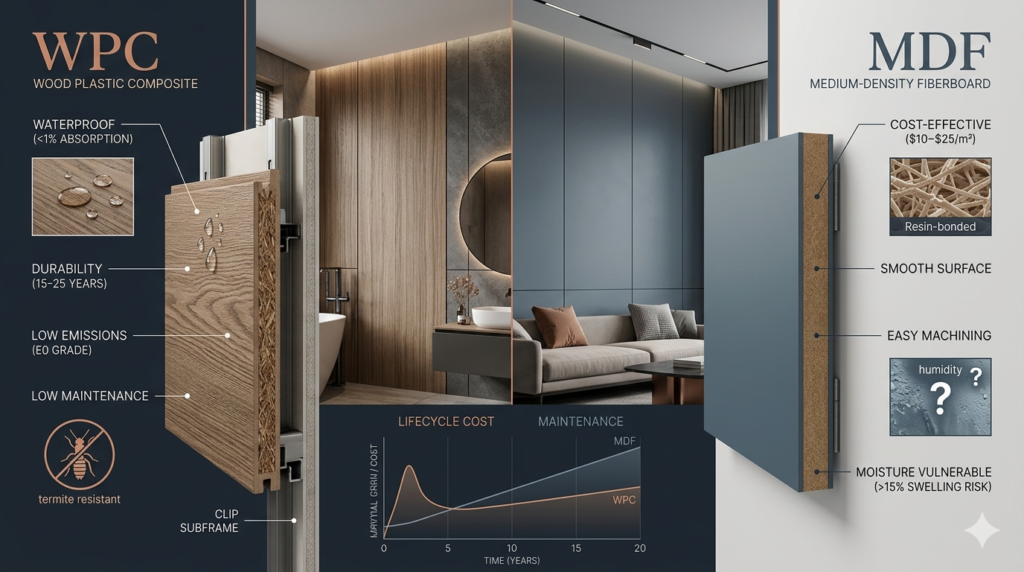
Which is better, WPC or MDF wall panels? WPC wall panels offer superior moisture resistance, durability (15–25 years), and low emissions, making them ideal for humid or long-term use. MDF panels are more affordable and easier to finish but are less durable and vulnerable to moisture, making them suitable mainly for dry interior environments.
TL;DR
WPC vs MDF wall panels refers to the comparison between wood-plastic composite panels and medium-density fiberboard used for interior wall applications. WPC provides better durability, water resistance, and lower VOC emissions, while MDF is cost-effective and smooth for decorative finishes. For bathrooms, kitchens, and commercial use, WPC is the preferred choice; MDF works best in dry, budget-sensitive indoor projects.
What Does WPC vs MDF Wall Panels Mean?
WPC vs MDF wall panels refers to the evaluation of two widely used wall cladding materials based on performance, cost, and environmental impact. This comparison helps architects, contractors, and homeowners determine the most suitable material for specific use cases.
WPC (Wood Plastic Composite) is a material composed of 50–70% wood fibers combined with thermoplastics such as polyethylene or polypropylene. MDF (Medium-Density Fiberboard) is an engineered wood product made by compressing wood fibers with synthetic resins under high pressure and temperature. These materials differ significantly in durability, moisture resistance, and lifecycle cost.
Material Composition and Manufacturing Differences
WPC panels are manufactured using extrusion technology, combining wood powder, plastic polymers, and additives like UV stabilizers and coupling agents. This process creates a dense, non-porous structure with water absorption rates typically below 1%.
MDF panels are produced by breaking down hardwood or softwood fibers and bonding them with urea-formaldehyde resins. The panels are then compressed into sheets with densities ranging from 600 to 800 kg/m³. According to industry data, WPC panels can exceed 900 kg/m³ density, contributing to improved mechanical strength and dimensional stability.
Performance Comparison: WPC vs MDF Wall Panels
| Factor | WPC Wall Panels | MDF Wall Panels |
|---|---|---|
| Moisture Resistance | Excellent (<1% absorption) | Poor (swelling risk >15%) |
| Lifespan | 15–25 years | 8–15 years |
| Formaldehyde Emissions | Low to zero (E0 grade) | Moderate (E1/E2 levels) |
| Maintenance | Low | Moderate to high |
| Cost | $15–$40/m² | $10–$25/m² |
| Surface Finish | Textured or laminated | Smooth, paint-ready |
Key Benefits and Limitations
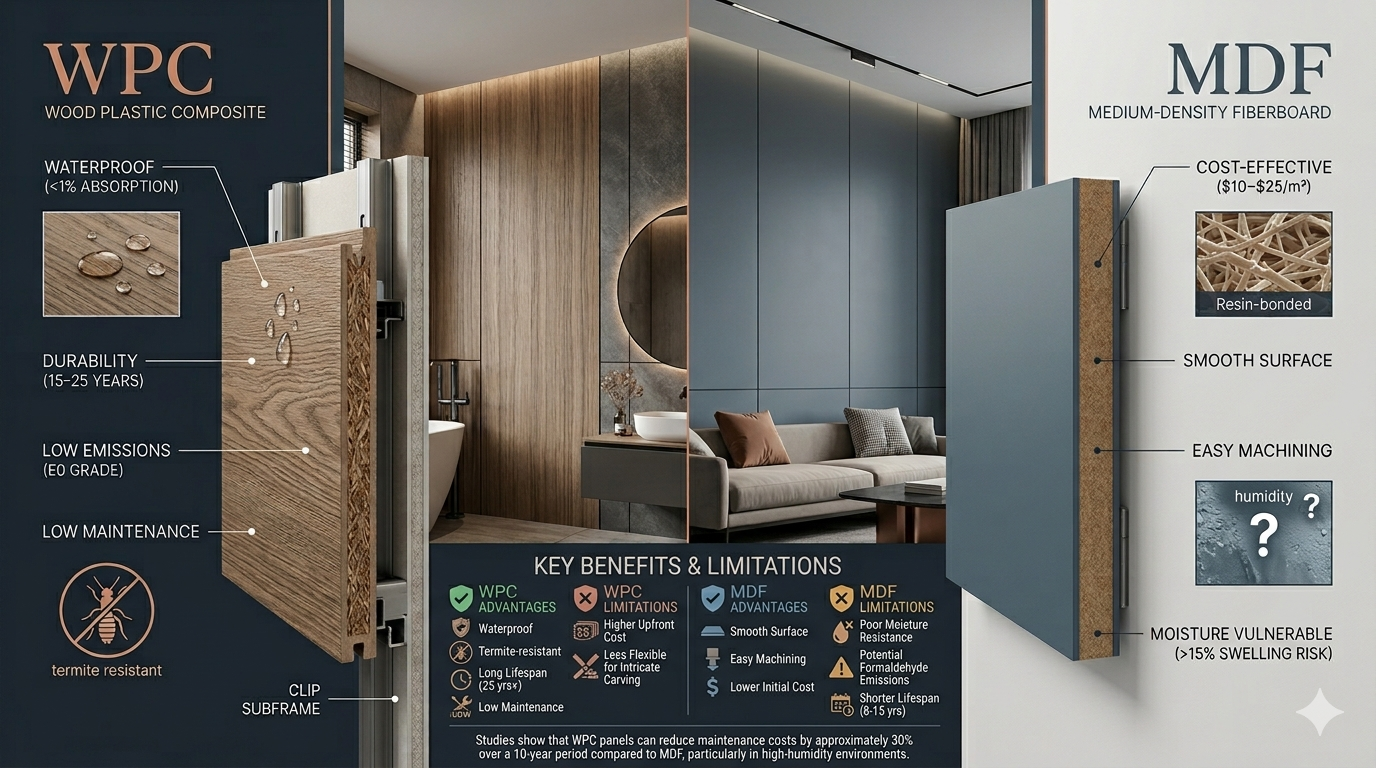
- WPC Advantages: Waterproof, termite-resistant, long lifespan (up to 25 years), low maintenance
- WPC Limitations: Higher upfront cost, less flexible for intricate carving
- MDF Advantages: Smooth surface, easy machining, lower initial cost
- MDF Limitations: Poor moisture resistance, potential formaldehyde emissions, shorter lifespan
Studies show that WPC panels can reduce maintenance costs by approximately 30% over a 10-year period compared to MDF, particularly in high-humidity environments.
Cost Analysis and Lifecycle Value
Initial cost differences are often the deciding factor. MDF panels typically range from $10 to $25 per square meter, making them attractive for low-budget projects. WPC panels, priced between $15 and $40 per square meter, require a higher upfront investment.
However, lifecycle cost analysis tells a different story. According to industry data, WPC panels can last up to 60% longer than MDF and require significantly less maintenance. In real-world applications, MDF panels exposed to moisture may need replacement within 5–8 years, while WPC panels maintain structural integrity for over 15 years.
Installation Considerations and Best Practices
WPC panels are typically installed using clip systems or screws onto a subframe, allowing for ventilation and expansion gaps of 3–5 mm. This design helps prevent moisture accumulation and thermal deformation.
MDF panels are often glued or nailed directly onto walls. However, they require sealing and painting to protect against moisture. Improper installation or lack of sealing can reduce MDF lifespan by up to 50%, especially in humid conditions.
Real-World Applications
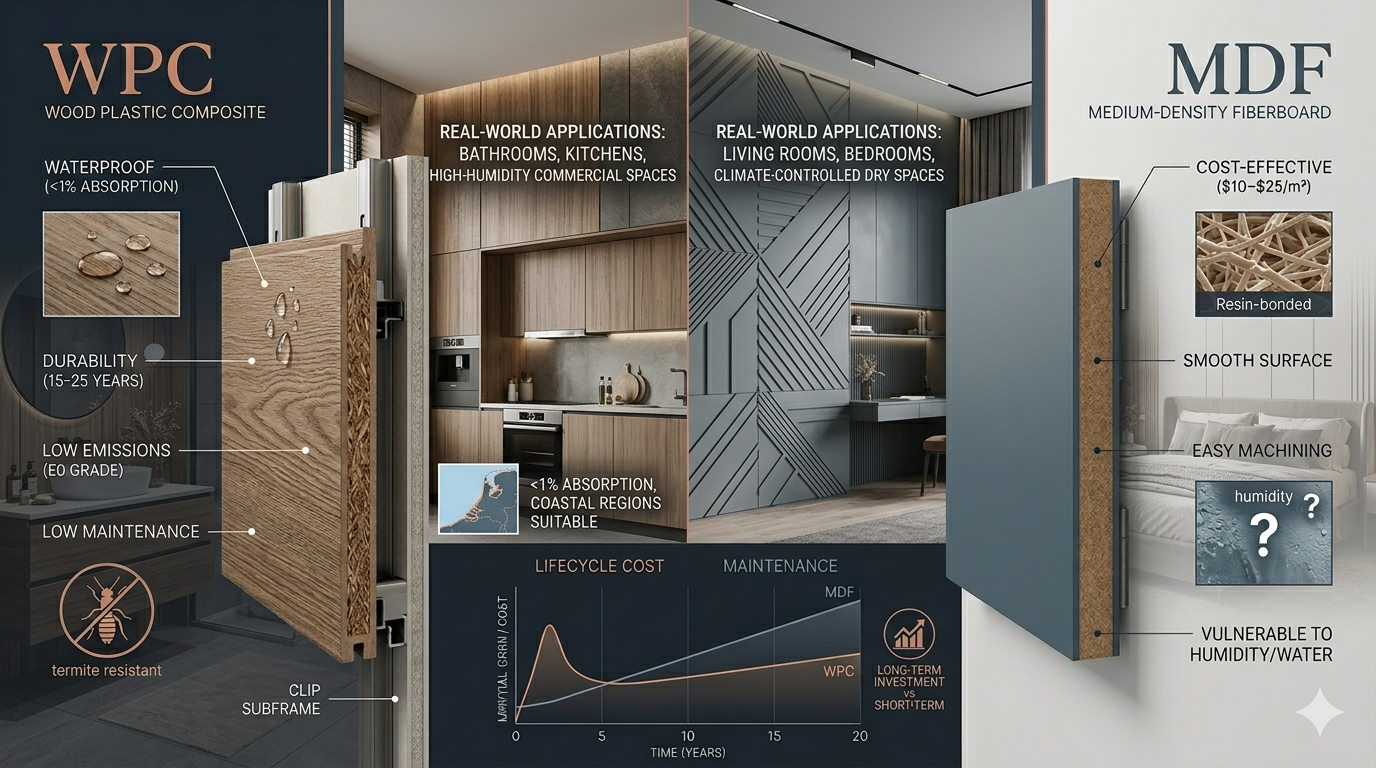
WPC wall panels are widely used in environments requiring durability and moisture resistance. These include bathrooms, kitchens, basements, and commercial spaces such as hotels and offices. Their low water absorption (<1%) makes them suitable for coastal or high-humidity regions.
MDF panels are commonly used in dry indoor settings such as living rooms, bedrooms, and decorative feature walls. In real-world applications, MDF performs well in climate-controlled environments but deteriorates quickly when exposed to water or high humidity.
Expert Insight
From a material engineering perspective, the choice between WPC and MDF depends on environmental exposure and lifecycle expectations. WPC panels provide superior resistance to moisture, biological degradation, and mechanical wear, making them suitable for long-term applications.
In contrast, MDF is optimized for cost efficiency and surface finish quality. However, its reliance on resin bonding makes it vulnerable to moisture and emissions concerns. For projects targeting sustainability certifications or long-term durability, WPC is generally the more reliable choice despite higher initial costs.
Key Questions Answered
Which material is better for long-term use?
WPC is better suited for long-term applications due to its 15–25 year lifespan, resistance to moisture, and low maintenance requirements. MDF, while cost-effective initially, may require replacement within 8–10 years in less controlled environments.
Is MDF suitable for humid environments?
MDF is not recommended for high-moisture areas. Its water absorption can exceed 15%, leading to swelling and structural damage. WPC panels, with less than 1% absorption, are a more reliable alternative.
Which material is more cost-effective over time?
Although MDF has a lower upfront cost, WPC is often more cost-effective over 10–15 years due to reduced maintenance and longer lifespan, especially in demanding environments.
WPC Wall Panel Factory China : Complete Buyer Guide
Learn how to choose a reliable WPC wall panel factory in China. Explore costs, manufacturing, certifications, and sourcing tips for global buyers.

WPC Wall Panel Manufacturer : How to Choose the Right Supplier
Discover how to choose a reliable WPC wall panel manufacturer. Learn key factors like quality, certifications, pricing, and supplier evaluation.
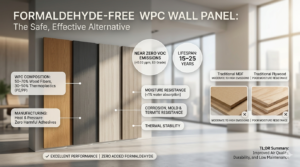
Formaldehyde Free WPC Wall Panel Guide
Learn what formaldehyde free WPC wall panels are, their benefits, cost, durability, and why they are safer for indoor use.