
TL;DR
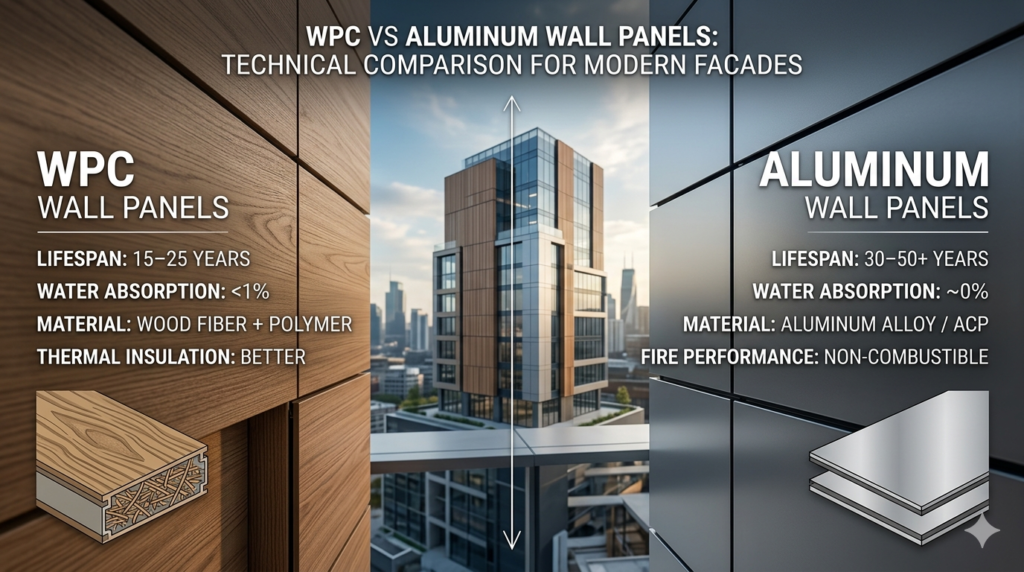
WPC (Wood Plastic Composite) wall panels and aluminum wall panels differ in structure, durability, fire performance, and thermal behavior. WPC panels provide moisture resistance, insulation, and wood-like aesthetics with lifespans of 15–25 years. Aluminum panels offer superior strength, non-combustibility, and durability of 30–50+ years. The optimal choice depends on building height, environmental exposure, and lifecycle cost strategy.
What are WPC wall panels?
WPC wall panels are composite materials made from wood fibers (typically 50–70%) combined with thermoplastics such as polyethylene (PE), polypropylene (PP), or PVC. This engineered composition improves dimensional stability and moisture resistance.
WPC wall panels refer to non-structural cladding systems designed for decorative and protective applications. According to industry data, water absorption is typically below 1%, significantly lower than natural wood.
They are widely used in residential and light commercial projects where cost efficiency and aesthetic consistency are important.
What are aluminum wall panels?
Aluminum wall panels are metal cladding systems made from solid aluminum sheets or aluminum composite panels (ACP), typically consisting of two aluminum layers bonded to a core.
Aluminum wall panels refer to high-performance facade materials engineered for durability, fire resistance, and structural integrity. They are commonly coated with PVDF or polyester finishes for corrosion and UV resistance.
These panels are widely used in high-rise buildings, airports, and large commercial developments where long-term performance is critical.
How do WPC and aluminum wall panels differ in material composition?
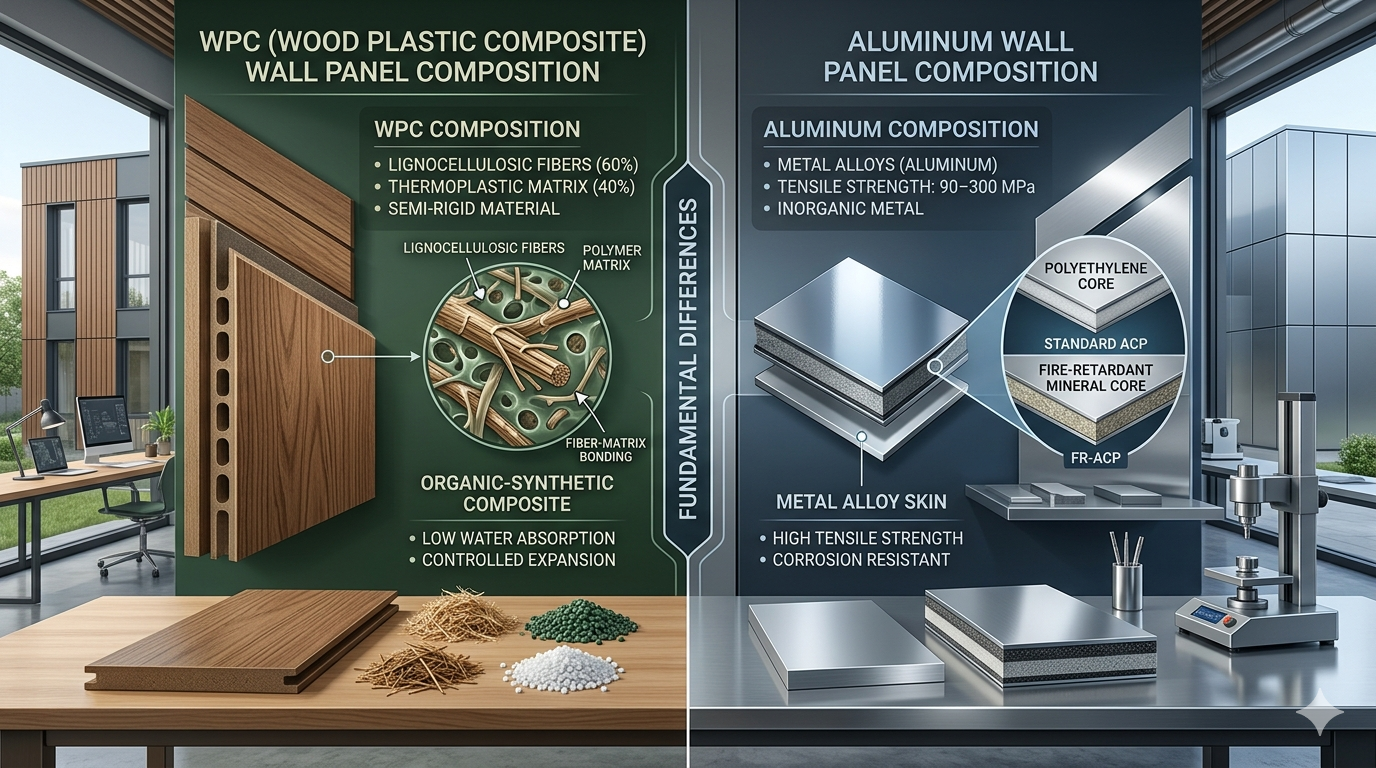
WPC panels consist of lignocellulosic fibers embedded in a thermoplastic matrix, typically in a 60:40 ratio. This creates a semi-rigid material with controlled expansion and low water absorption.
Aluminum panels are composed of metal alloys with high tensile strength, typically ranging from 90 to 300 MPa. ACP panels may include polyethylene or fire-retardant mineral cores.
The fundamental difference is that WPC is an organic–synthetic composite, while aluminum is a fully inorganic metal, resulting in different mechanical and environmental behaviors.
What are the key performance differences?
Core Performance Metrics
- Lifespan
- WPC: 15–25 years
- Aluminum: 30–50+ years
- Water Resistance
- WPC: <1% absorption
- Aluminum: 0% absorption
- Fire Performance
- WPC: Limited, depends on formulation
- Aluminum: Non-combustible (meets strict codes)
- Strength
- WPC: Moderate (non-load-bearing)
- Aluminum: High (structural capability)
Industry benchmarks show aluminum panels can last up to 2× longer than WPC in high-exposure environments.
Comparison Table: WPC vs Aluminum Wall Panels
| Parameter | WPC Wall Panel | Aluminum Wall Panel |
|---|---|---|
| Material Type | Wood fiber + polymer | Aluminum alloy / ACP |
| Lifespan | 15–25 years | 30–50+ years |
| Water Absorption | <1% | ~0% |
| Fire Rating | Moderate | High (A-class possible) |
| Tensile Strength | Low–moderate | 90–300 MPa |
| Thermal Conductivity | 0.2–0.3 W/m·K | ~205 W/m·K |
| Maintenance | Low | Very low |
| Initial Cost | Lower | Higher |
| Application Type | Decorative | Structural + facade |
Which material performs better in thermal and acoustic behavior?
WPC panels provide better insulation due to their composite structure. Their thermal conductivity is approximately 0.2–0.3 W/m·K, which helps reduce energy transfer in building envelopes.
Aluminum panels have very high thermal conductivity, around 205 W/m·K, making them poor insulators unless combined with insulation systems.
In acoustic performance, WPC panels can reduce noise transmission by 20–30%, while aluminum panels typically reflect sound rather than absorb it.
How do WPC and aluminum panels compare in weather resistance?
Aluminum panels offer superior resistance to extreme weather conditions, including UV radiation, temperature fluctuations, and corrosion. PVDF coatings can maintain performance for over 20 years without significant degradation.
WPC panels provide strong resistance to moisture and insects but are less resistant to prolonged UV exposure. Color fading may occur after 5–10 years depending on quality and environment.
In coastal or industrial areas, aluminum panels generally outperform WPC due to their chemical and salt corrosion resistance.
What are the cost differences?
Cost Breakdown
WPC Panels
- Lower material cost
- Lower installation cost (lightweight)
- Higher replacement frequency
Aluminum Panels
- 10–30% higher initial cost
- Minimal maintenance cost
- Longer replacement cycle
👉 Lifecycle Insight:
Aluminum panels often become more cost-effective over 30–40 years, especially in commercial projects.
Where are WPC and aluminum panels typically used?
WPC Panel Applications
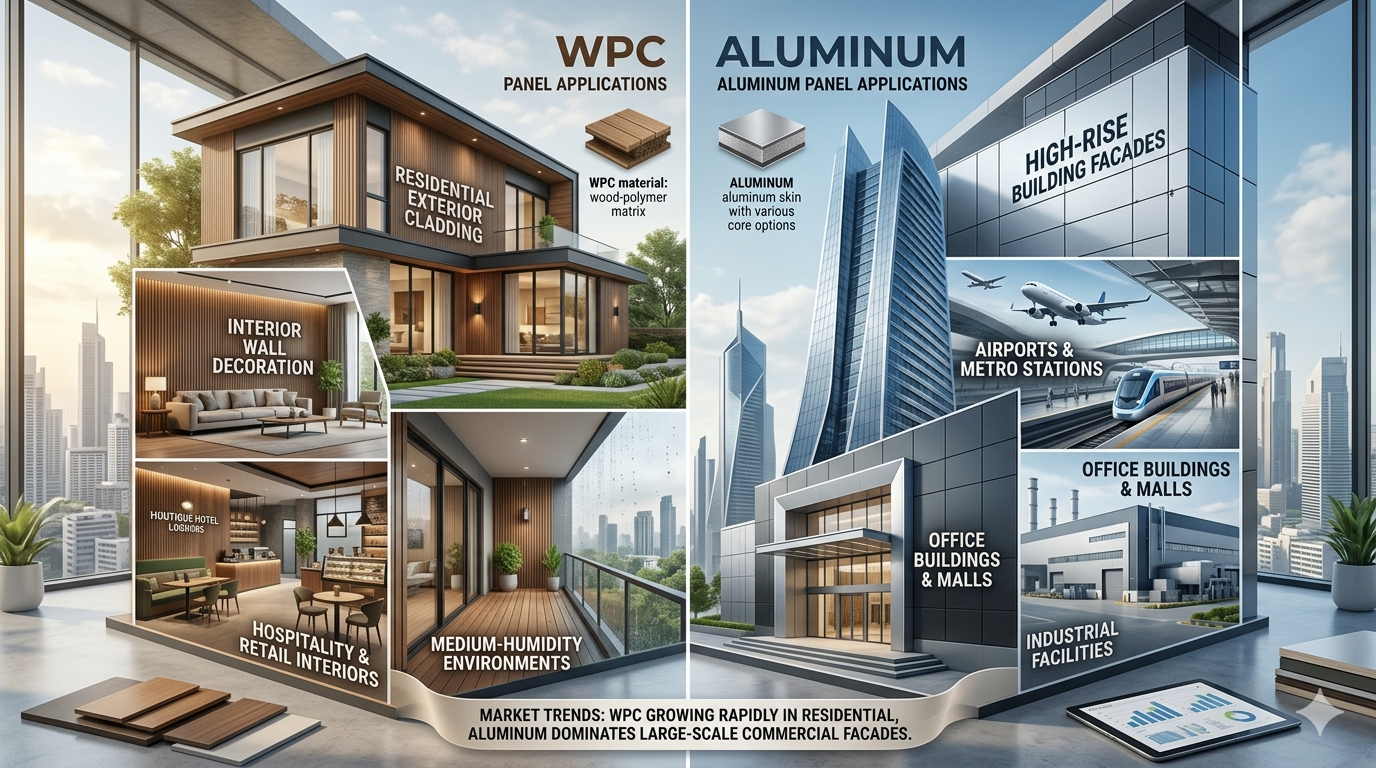
- Residential exterior cladding
- Interior wall decoration
- Hospitality and retail interiors
- Medium-humidity environments
Aluminum Panel Applications
- High-rise building facades
- Airports and metro stations
- Office buildings and malls
- Industrial facilities
According to market trends, aluminum dominates large-scale commercial facades, while WPC is growing rapidly in residential construction.
What are the advantages and limitations?
WPC Wall Panels
Advantages:
- Moisture-resistant (<1%)
- Wood-like appearance
- Better thermal insulation
- Lower upfront cost
Limitations:
- Lower fire resistance
- Limited structural strength
- Thermal expansion (2–3 mm/m)
Aluminum Wall Panels
Advantages:
- High strength and durability
- Non-combustible
- Long lifespan (30–50+ years)
- Excellent weather resistance
Limitations:
- Poor insulation performance
- Higher initial cost
- Susceptible to denting
What factors should guide material selection?
Decision Framework
- Building Height
- High-rise → Aluminum required
- Low-rise → WPC suitable
- Fire Regulations
- Strict codes → Aluminum preferred
- Flexible codes → WPC acceptable
- Thermal Performance
- Insulation priority → WPC
- Structural priority → Aluminum
- Budget Strategy
- Short-term → WPC
- Long-term → Aluminum
Expert Insight: Hybrid facade systems are becoming standard
Modern architecture increasingly combines WPC and aluminum panels to optimize both performance and cost.
- Aluminum is used for structural and high-exposure zones
- WPC is used for decorative and insulated sections
This hybrid approach can reduce total project cost by 10–20% while maintaining compliance with building codes and performance requirements.
WPC vs SPC Wall Panels : What’s the Difference?
Compare WPC vs SPC wall panels by materials, structure, waterproofing, durability, installation, cost, and applications to choose the right panel.
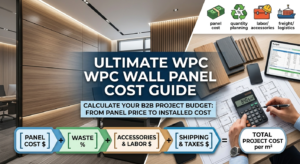
WPC Wall Panel Cost Calculator: Complete Project Cost Guide
Calculate WPC wall panel costs using wall area, panel price, waste, accessories, labor, shipping, and installation expenses.
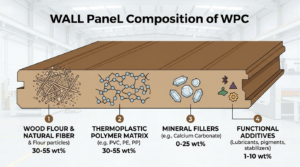
What Is WPC Wall Panel Made Of ? Materials, Composition & Manufacturing
Learn what WPC wall panels are made of, including wood fiber, plastic polymers, additives, material composition, and the complete manufacturing process.