
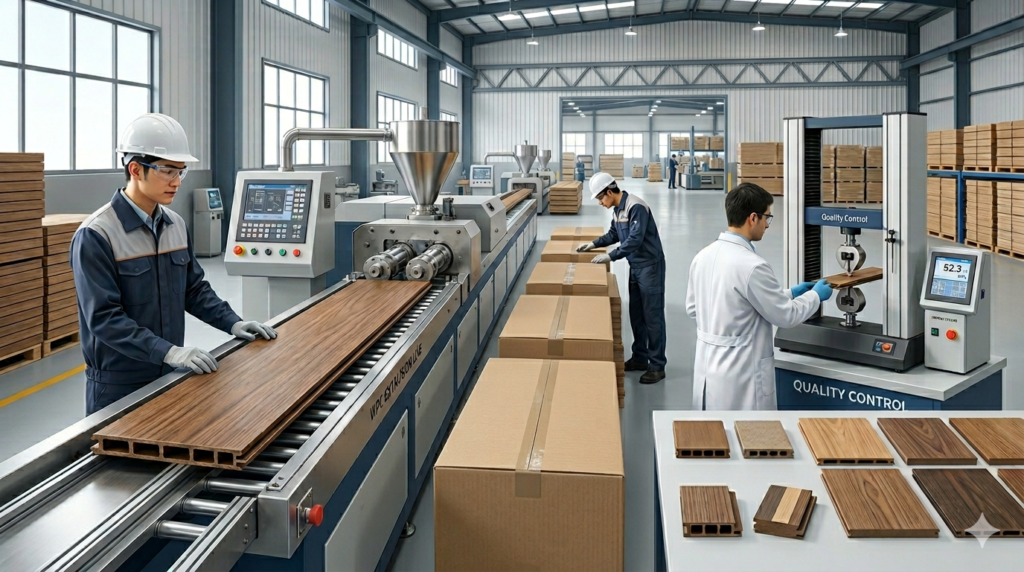
WPC Wall Panel Manufacturer: How to Choose the Right Supplier
TL;DR (Answer First)
Choosing the right WPC (Wood-Plastic Composite) wall panel manufacturer directly determines product durability, installation efficiency, compliance, and long-term project success. The best suppliers combine verified raw material quality, advanced extrusion technology, strict quality control systems, global certifications (CE, SGS), and proven export experience. Avoid suppliers that lack transparency, consistent quality standards, or technical support. A reliable manufacturer is not just a vendor—it is a long-term performance partner.
What Is a WPC Wall Panel Manufacturer?
A WPC wall panel manufacturer is a company that produces composite panels made from a blend of wood fibers (or flour) and thermoplastics (such as PVC, PE, or PP) through extrusion or co-extrusion processes.
These manufacturers typically handle:
- Raw material formulation
- Profile extrusion and surface finishing
- Structural design (hollow, solid, co-extruded)
- Performance testing (waterproofing, fire resistance, UV stability)
- Packaging and export logistics
Unlike traders, true manufacturers control the entire production chain, which is critical for consistent quality and cost efficiency.
Why Choosing the Right Manufacturer Matters
1. Product Performance Depends on Manufacturing Precision
WPC panels are highly sensitive to:
- Temperature control during extrusion
- Material ratio consistency
- Cooling and shaping processes
Poor control leads to:
- Warping
- Color inconsistency
- Reduced lifespan (often <3 years vs. 10–20 years for high-quality panels)
2. Hidden Costs Come from Low-Quality Suppliers
Cheap suppliers often result in:
- Installation failures
- Increased labor costs
- Replacement expenses
- Warranty disputes
A 10–20% lower upfront cost can lead to 2–3x higher lifecycle costs.
What Are the Key Factors When Choosing a WPC Wall Panel Supplier?
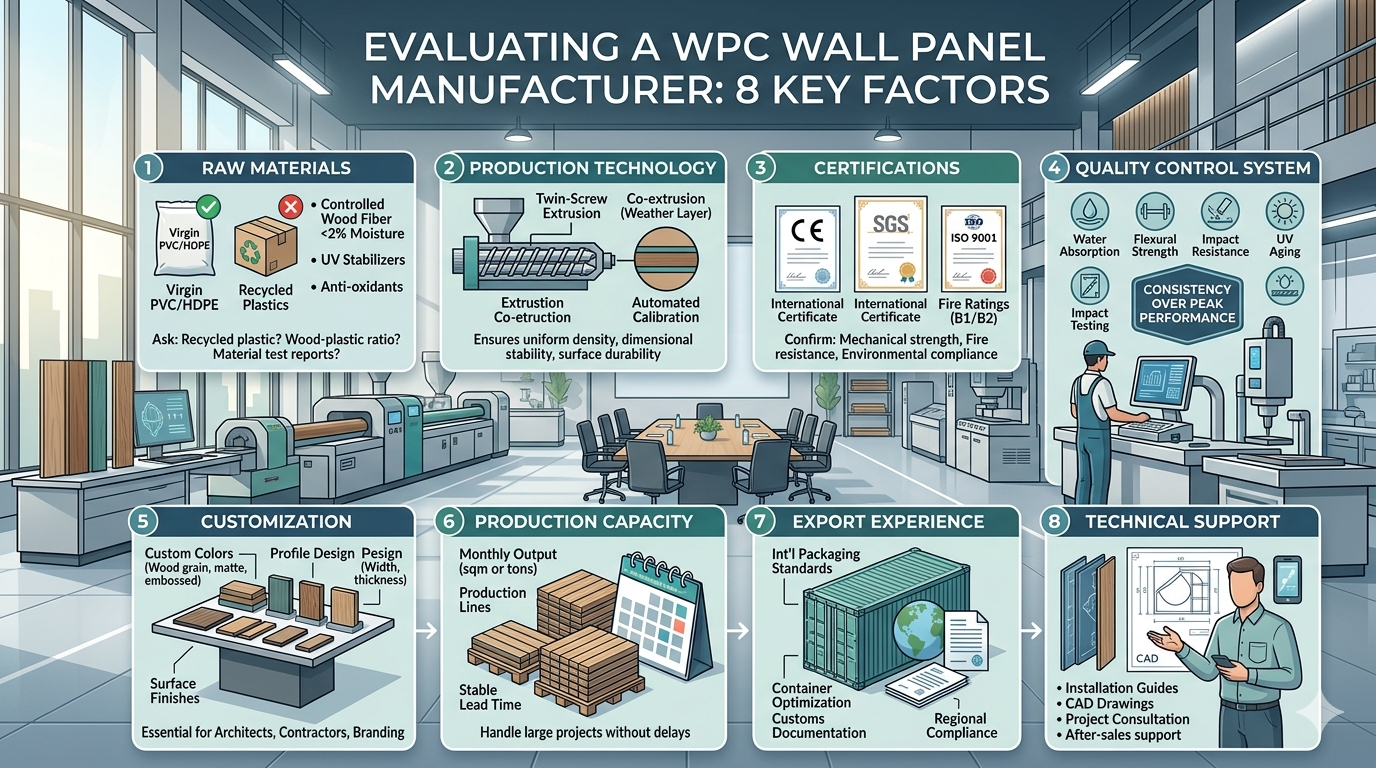
1. What Raw Materials Do They Use?
High-quality WPC panels typically use:
- Virgin PVC or HDPE (not recycled plastics)
- Controlled wood fiber moisture content (<2%)
- UV stabilizers and anti-oxidants
Red flag: Extremely low pricing often indicates recycled or contaminated materials.
2. Do They Have Advanced Production Technology?
Look for manufacturers with:
- Twin-screw extrusion systems
- Co-extrusion (for weather-resistant outer layers)
- Automated calibration and cooling systems
Why it matters:
- Ensures uniform density
- Improves dimensional stability
- Enhances surface durability
3. What Certifications Do They Hold?
Reliable manufacturers provide internationally recognized certifications:
- CE (European conformity)
- SGS testing reports
- ISO 9001 (Quality Management)
- Fire ratings (B1/B2 depending on region)
These certifications confirm:
- Mechanical strength
- Fire resistance
- Environmental compliance
4. How Strong Is Their Quality Control System?
Professional manufacturers implement:
- Incoming raw material inspection
- In-line production monitoring
- Finished product testing
Typical tests include:
| Test Type | Purpose |
|---|---|
| Water absorption | Prevent swelling/deformation |
| Flexural strength | Structural stability |
| Impact resistance | Durability under stress |
| UV aging test | Outdoor performance |
Key insight: Consistency matters more than peak performance.
5. Do They Offer Customization Capabilities?
Top manufacturers support:
- Custom colors (wood grain, matte, embossed)
- Profile design (width, thickness)
- Surface finishes (coating, lamination)
- Fire-rated or acoustic panels
Customization is essential for:
- Architects
- Contractors
- Branding projects
6. What Is Their Production Capacity?
Evaluate:
- Monthly output (sqm or tons)
- Number of production lines
- Lead time stability
A strong supplier can:
- Handle large projects without delays
- Maintain consistent supply quality
7. Do They Have Export Experience?
Export-ready manufacturers understand:
- International packaging standards
- Container optimization
- Customs documentation
- Regional compliance requirements
Key advantage: Reduces risk of shipping damage and delays.
8. What Technical Support Do They Provide?
A professional supplier offers:
- Installation guides
- CAD drawings
- Project consultation
- After-sales support
This is critical for:
- Reducing installation errors
- Improving efficiency on-site
Manufacturer vs Trader: What’s the Difference?
| Factor | Manufacturer | Trader |
|---|---|---|
| Price | More competitive | Higher markup |
| Quality control | Direct control | Limited visibility |
| Customization | High flexibility | Limited |
| Technical support | Strong | Weak or outsourced |
| Lead time | Stable | Depends on factory |
Conclusion: Always prioritize working directly with manufacturers for large or long-term projects.
What Are Common Mistakes When Choosing a Supplier?
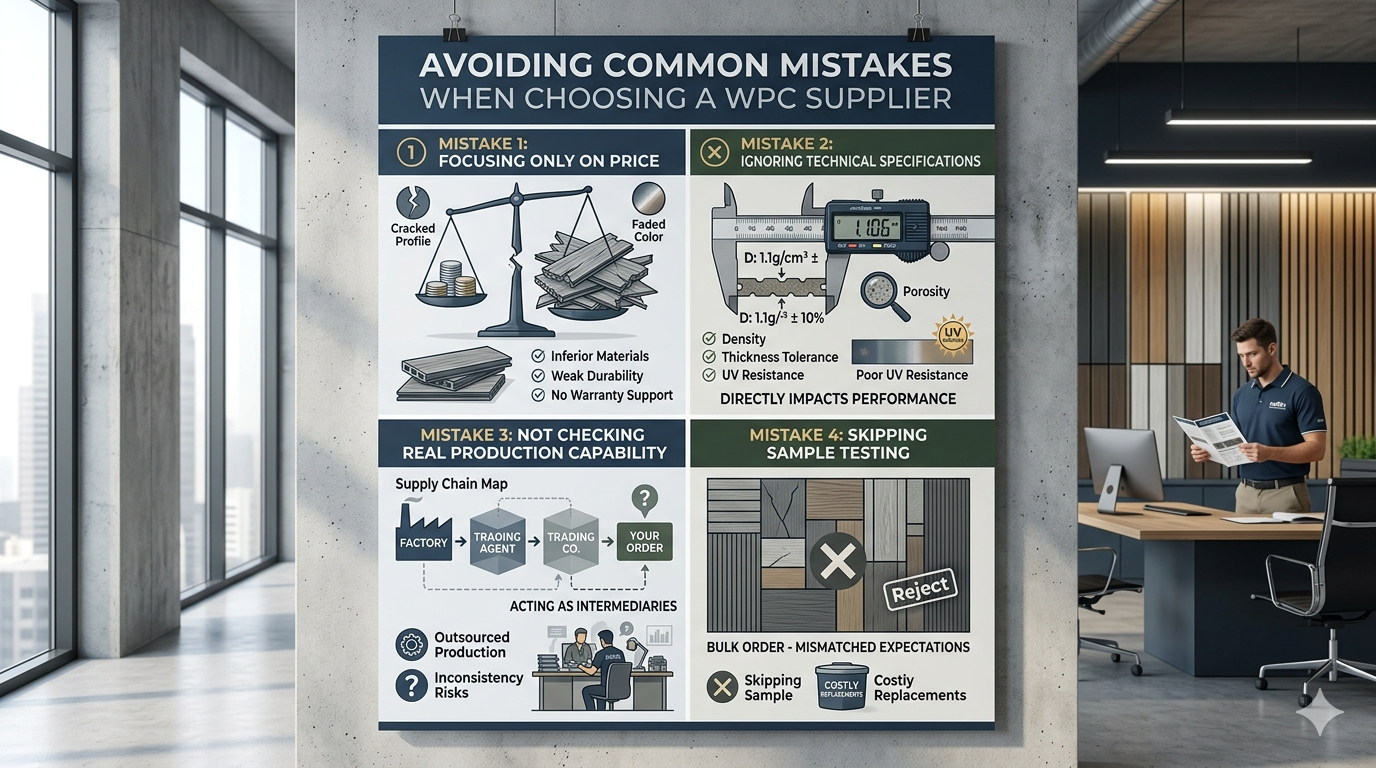
1. Focusing Only on Price
Lowest price often means:
- Inferior materials
- Weak durability
- No warranty support
2. Ignoring Technical Specifications
Buyers often overlook:
- Density
- Thickness tolerance
- UV resistance
These directly impact performance.
3. Not Checking Real Production Capability
Some suppliers:
- Outsource production
- Act as intermediaries
This creates inconsistency risks.
4. Skipping Sample Testing
Bulk orders without testing lead to:
- Mismatched expectations
- Costly replacements
What Defines a High-Quality WPC Wall Panel Manufacturer?
A top-tier manufacturer typically demonstrates:
- 10+ years of industry experience
- Stable international clients
- Certified quality systems
- Transparent production processes
- Continuous product innovation
They focus on:
- Long-term partnerships
- Consistent quality
- Technical reliability
How Does a Good Supplier Improve Your Business?
For Distributors
- Stable inventory supply
- Lower return rates
- Better customer satisfaction
For Contractors
- Faster installation
- Reduced material waste
- Reliable project timelines
For Architects
- Greater design flexibility
- Consistent material performance
Future Trends in WPC Manufacturing
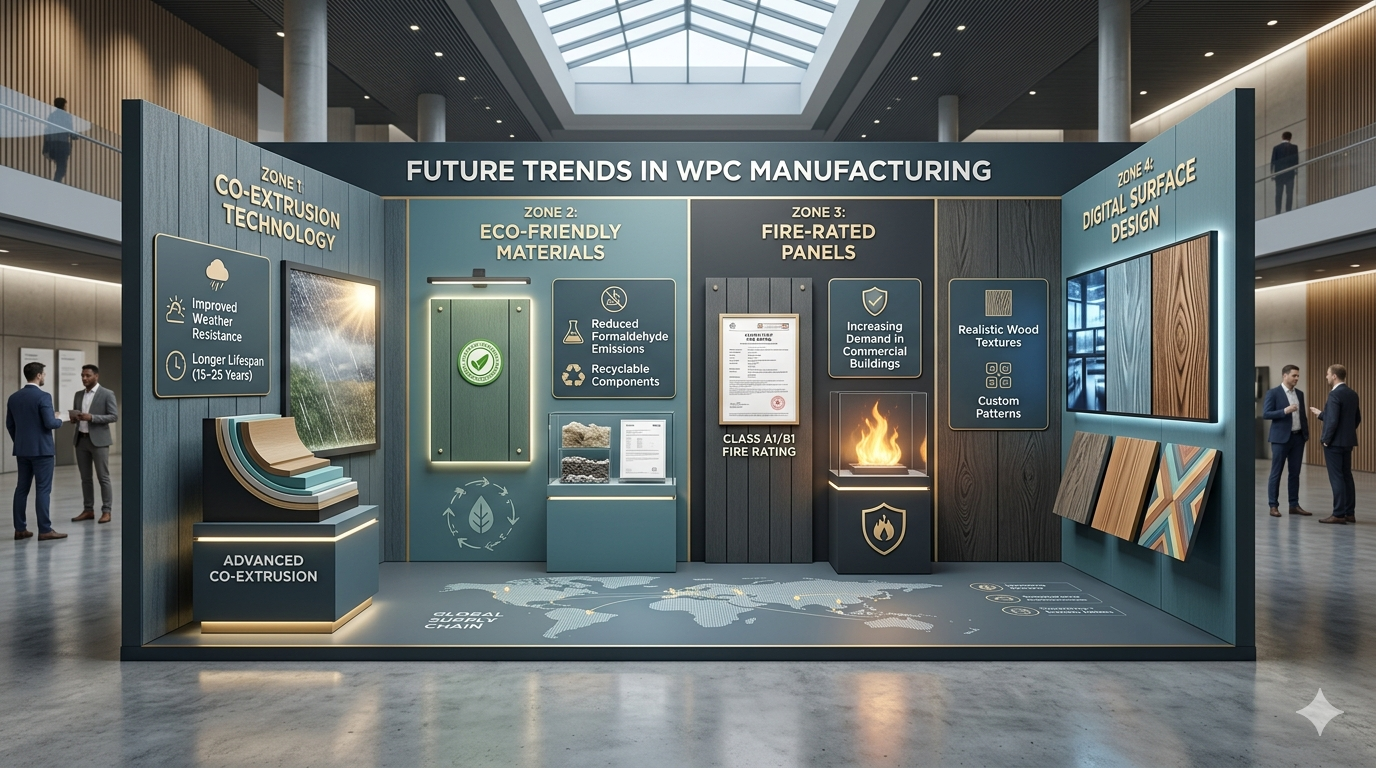
Understanding trends helps you choose forward-thinking suppliers:
1. Co-Extrusion Technology
- Improved weather resistance
- Longer lifespan (15–25 years)
2. Eco-Friendly Materials
- Reduced formaldehyde emissions
- Recyclable components
3. Fire-Rated Panels
- Increasing demand in commercial buildings
4. Digital Surface Design
- Realistic wood textures
- Custom patterns
Conclusion
Choosing the right WPC wall panel manufacturer is a strategic decision that affects cost, quality, durability, and brand reputation. The best suppliers are not simply low-cost producers—they are technically capable, quality-driven, and globally experienced partners.
A structured evaluation—focused on materials, technology, certifications, and support—ensures you select a supplier that delivers consistent, long-term value.
WPC vs SPC Wall Panels : What’s the Difference?
Compare WPC vs SPC wall panels by materials, structure, waterproofing, durability, installation, cost, and applications to choose the right panel.
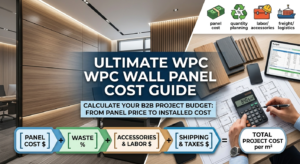
WPC Wall Panel Cost Calculator: Complete Project Cost Guide
Calculate WPC wall panel costs using wall area, panel price, waste, accessories, labor, shipping, and installation expenses.
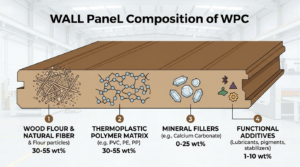
What Is WPC Wall Panel Made Of ? Materials, Composition & Manufacturing
Learn what WPC wall panels are made of, including wood fiber, plastic polymers, additives, material composition, and the complete manufacturing process.