
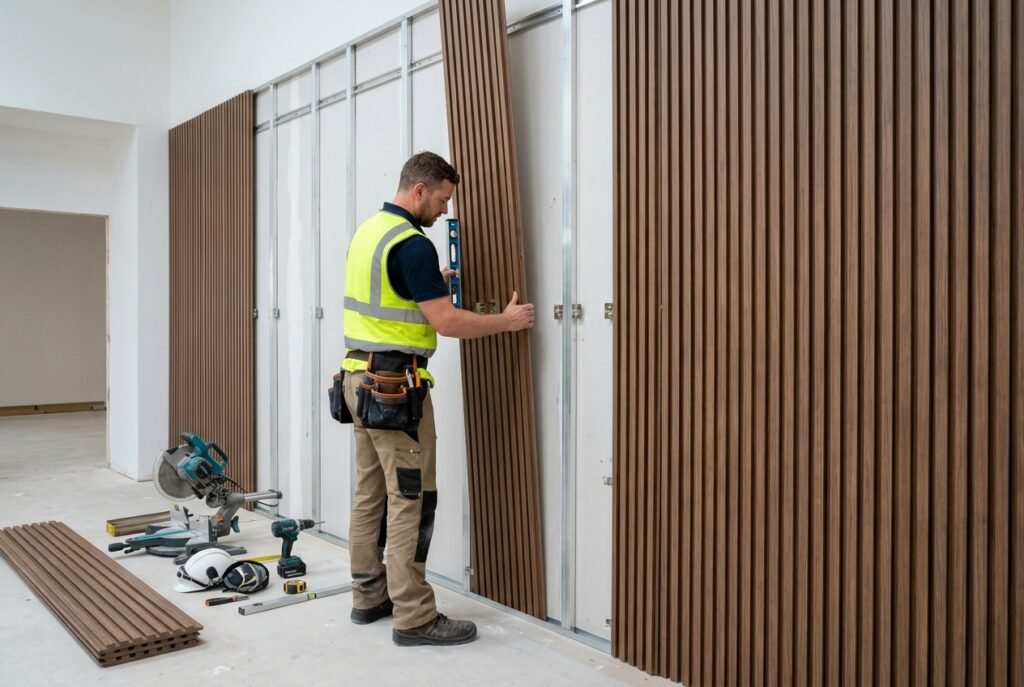
1. What Are WPC Fluted Wall Panels?
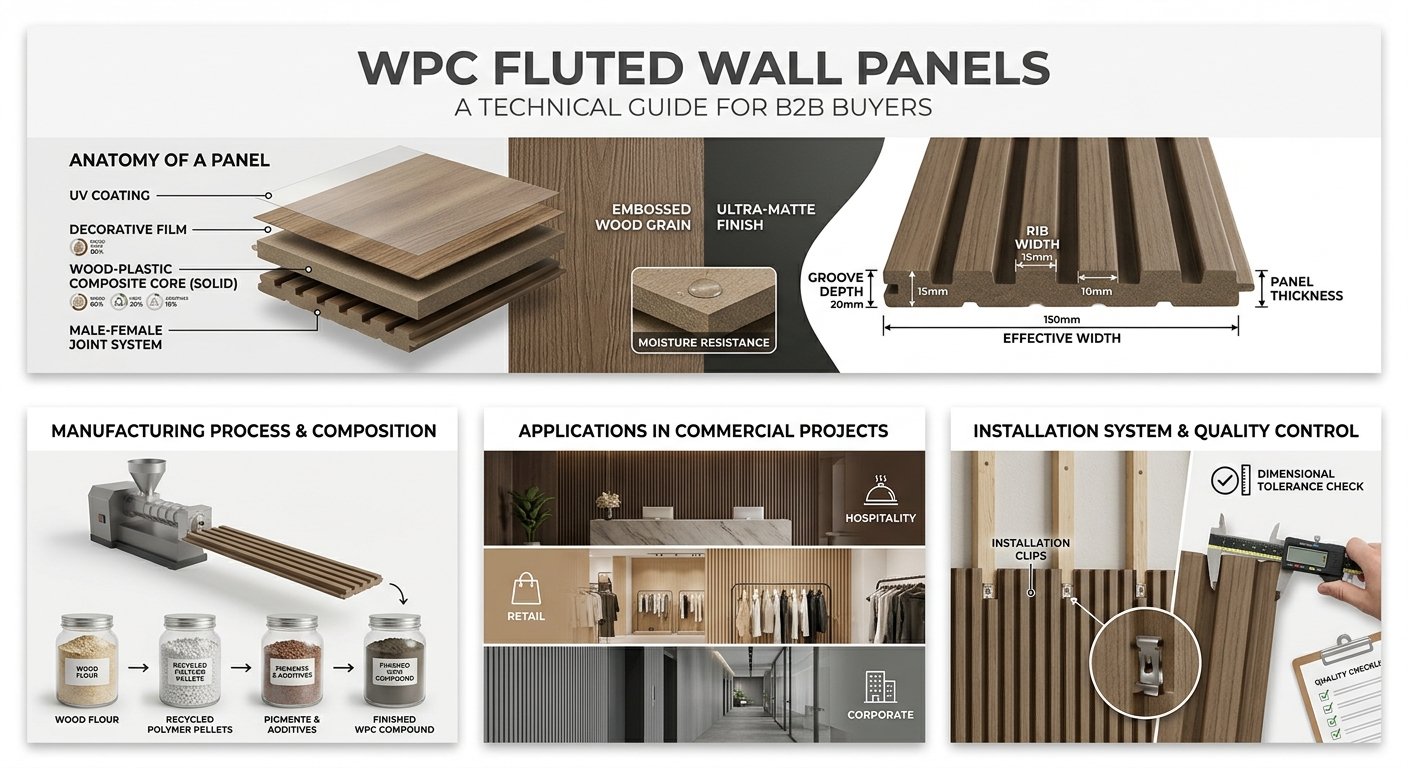
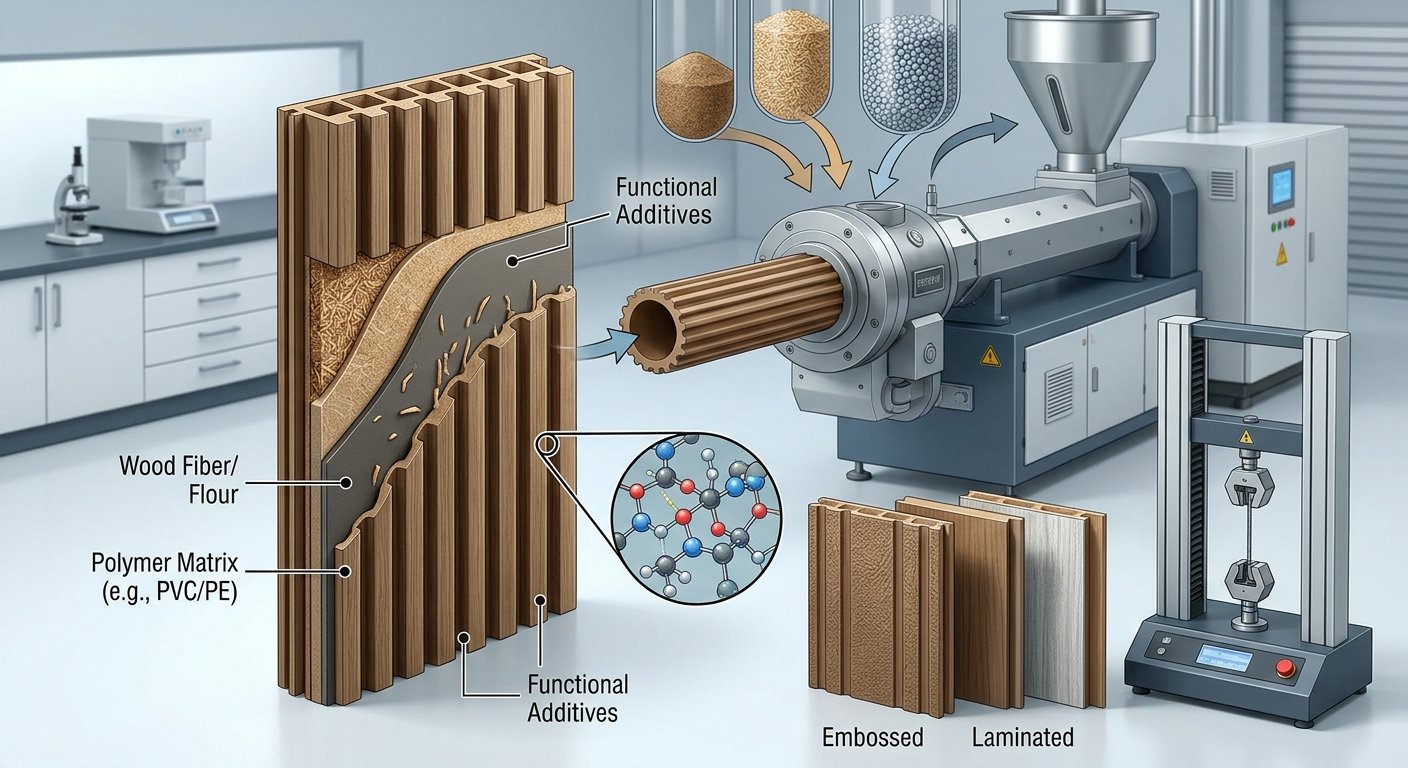
WPC fluted wall panels are decorative cladding profiles featuring repeated grooves and raised ribs that create a three-dimensional linear surface. WPC stands for wood-plastic composite, a material generally made from wood fiber or wood flour, a polymer matrix, and functional additives.
These panels combine a manufactured profile with a decorative surface, making them suitable for feature walls, hospitality interiors, retail environments, offices, and residential developments. Their performance depends on the actual formulation, profile geometry, surface treatment, and installation system.
For B2B buyers, it is important to distinguish genuine wood-polymer composite products from PVC profiles marketed using similar terminology. Confirming the material composition helps ensure that the product matches the project’s specification and purchasing requirements.
2. Material Composition and Manufacturing
WPC fluted panels are commonly manufactured through extrusion. Raw materials are compounded, heated, and formed through a die to produce a continuous profile. The profile is then calibrated, cooled, cut to length, and finished according to the product design.
Typical material components include:
- Wood fiber or wood flour: Contributes to the composite structure and may influence texture and processing.
- Polymer matrix: Often PVC, PE, or PP, depending on the product formulation.
- Additives: May include processing aids, stabilizers, pigments, and other modifiers.
- Decorative surface: May be embossed, coated, laminated, or finished using other compatible processes.
There is no universal WPC formulation. Buyers should request the manufacturer’s technical datasheet and verify whether the product is a wood-filled composite, a PVC-based profile, or another composite construction. This distinction can affect product performance, classification, and suitability for the intended application.
3. Fluted Profile Design and Technical Specifications
The profile geometry determines the panel’s visual appearance and influences material consumption, weight, rigidity, and installation requirements.
| Specification | What Buyers Should Check |
|---|---|
| Overall width | Coverage per panel and joint layout |
| Panel length | Wall height, cutting waste, and shipping constraints |
| Thickness or profile height | Fit, rigidity, and available fixing space |
| Groove depth and spacing | Shadow effect and design consistency |
| Core structure | Solid, hollow, or ribbed construction |
| Surface finish | Embossing, film, coating, or other treatment |
| Unit weight | Handling, fixing requirements, and freight calculation |
| Joint design | Edge alignment and connection method |
Exact dimensions vary by manufacturer and model. Buyers should compare profile drawings rather than relying only on product photographs. For large projects, request a physical sample to verify groove spacing, surface texture, color, and connection details before approving production.
4. Key Performance Characteristics
WPC fluted panels can offer several practical advantages in suitable applications.
Moisture resistance: Many formulations perform better under everyday indoor moisture exposure than untreated wood. However, water resistance varies by composition and does not automatically make every panel suitable for continuous water exposure.
Dimensional consistency: Extrusion enables repeatable profile production when process controls and tooling are maintained. Actual tolerances should be confirmed in writing.
Decorative durability: Surface performance depends on the coating, film, embossing process, and resistance to scratches, abrasion, and cleaning agents.
Maintenance: Finished panels can often be cleaned with a soft cloth and a compatible mild cleaner, reducing the need for routine painting compared with some timber finishes.
These properties must be verified for the specific product. Do not assume that every WPC panel is fire-rated, UV-resistant, waterproof, or suitable for exterior installation without supporting documentation.
5. Residential and Commercial Applications
WPC fluted panels are used where designers want a linear decorative surface and repeatable installation dimensions.
| Application | Procurement Consideration |
|---|---|
| Hotels and serviced apartments | Color consistency across rooms |
| Office reception areas | Surface appearance and impact exposure |
| Retail stores | Brand colors and repeat-order availability |
| Residential feature walls | Profile design and ease of maintenance |
| Restaurants | Cleaning requirements and applicable fire regulations |
| Showrooms and commercial developments | Bulk availability and replacement stock |
For public buildings and commercial interiors, check local fire regulations and the project specification before selecting a panel. If the installation is near heat sources, exposed to direct sunlight, or located in a high-humidity area, confirm that the product is specifically suitable for those conditions.
6. Installation Requirements and Common Risks
Installation quality affects alignment, appearance, and service performance. Before installation, assess the substrate, moisture conditions, fixing method, and required support structure.
The installation plan should address:
- Wall flatness and substrate strength
- Compatible adhesives, clips, screws, or supporting battens
- Panel alignment and joint consistency
- Expansion allowances specified by the manufacturer
- Finishing trims for corners and exposed edges
- Cutting methods that minimize surface damage
Common problems include uneven grooves, visible joints, damaged edges, poor adhesion, and distortion caused by unsuitable installation conditions. Follow the manufacturer’s installation instructions and avoid assuming that one fixing method works for every profile or substrate.
7. Quality Control Before Bulk Purchasing
For importers, distributors, and project contractors, quality should be assessed against documented requirements rather than appearance alone.
A practical incoming-inspection checklist includes:
- Verify panel length, width, and profile dimensions against the approved drawing.
- Check color consistency and surface defects under suitable lighting.
- Inspect edges, joints, and packaging for transport damage.
- Compare unit weight with the agreed specification where relevant.
- Review technical documents for moisture, fire, or other required performance claims.
- Confirm batch identification and procedures for defective products.
For larger orders, agree on acceptance criteria before production and consider pre-shipment inspection. If a project requires specific fire-performance or environmental documentation, verify the applicable test method, report scope, product identity, and validity rather than relying on a general marketing statement.
8. Wholesale Pricing and Total Procurement Cost
WPC fluted panel pricing depends on material composition, profile dimensions, surface finish, customization, order quantity, packaging, and delivery terms. A deeper or more complex profile may consume more material than a simpler design, while customized finishes may involve additional setup costs.
B2B buyers should compare quotations using the same specifications and units. Some suppliers quote per piece or linear meter; others quote per square meter. These units are not directly interchangeable without the panel dimensions and effective coverage width.
Use this formula to evaluate the overall budget:
Total Procurement Cost = Panel Cost + Accessories + Packaging + Freight + Import Charges
Also account for cutting waste, inspection, local delivery, and storage where applicable. Request the minimum order quantity, production lead time, carton dimensions, gross weight, and container loading details before confirming a purchase.
9. How to Choose a Reliable WPC Fluted Wall Panel Manufacturer
A suitable manufacturer should be able to explain its material composition, profile options, production process, inspection procedures, and customization capabilities.
Before placing an order, request:
- A current product catalogue and technical datasheets
- Profile drawings and physical samples
- Available colors and surface finishes
- MOQ and production lead time
- Packaging specifications and loading estimates
- Quality-control procedures and relevant test reports
- Written quotation terms and after-sales responsibilities
For repeat orders, confirm how the manufacturer controls color variation and profile consistency between production batches. A competitive supplier is not simply one with a low price; it should also be able to deliver the specified product reliably and provide clear documentation.
Conclusion
WPC fluted wall panels combine a distinctive linear profile with the manufacturing flexibility of composite materials. For professional buyers, product selection should be based on verified composition, profile geometry, surface quality, application requirements, installation compatibility, and total procurement cost.
For wholesale and commercial projects, requesting technical datasheets, drawings, samples, and written quality criteria from a qualified manufacturer is the most reliable way to ensure that the delivered panels meet the project’s design and performance requirements.

WPC Wall Panel Wholesale Price: B2B Buying Guide
Discover WPC wall panel wholesale prices, key cost factors, bulk order discounts, shipping costs, and tips for sourcing directly from manufacturers.
WPC Wall Panel Manufacturer vs Trading Company: Which Is Better?
Compare WPC wall panel manufacturers and trading companies by price, customization, quality control, MOQ, lead time, and bulk purchasing to choose the right supplier.

WPC vs SPC Wall Panels : What’s the Difference?
Compare WPC vs SPC wall panels by materials, structure, waterproofing, durability, installation, cost, and applications to choose the right panel.