
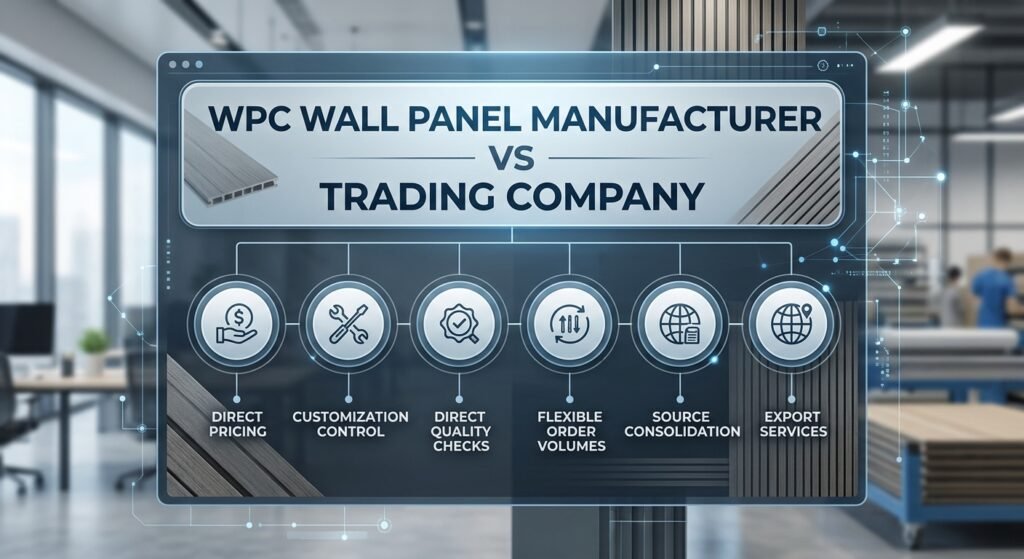
1. Introduction: Manufacturer vs Trading Company
When sourcing WPC wall panels from China, international buyers generally have two options: purchase directly from a manufacturer or work with a trading company. Both can provide export services, but their production capabilities, pricing structures, customization options, and supply-chain management may differ.
A WPC wall panel manufacturer produces panels in its own factory, while a trading company typically sources products from one or more manufacturers and sells them to overseas customers. Some businesses operate as both manufacturers and trading companies, so buyers should verify actual production capabilities rather than relying on company descriptions alone.
For importers, wholesalers, distributors, and large construction projects, the right choice depends on order volume, product requirements, supplier reliability, and total procurement cost.
2. Key Differences Between Manufacturers and Trading Companies
| Comparison Factor | Manufacturer | Trading Company |
|---|---|---|
| Production | Operates its own production facilities | Usually outsources production |
| Price structure | Direct factory pricing may be available | May include a trading margin |
| Customization | Often offers direct production coordination | Depends on factory relationships |
| Quality control | Can manage production inspections directly | Relies on supplier controls and inspections |
| Product range | Usually focused on specific product categories | May offer products from multiple factories |
| MOQ | Depends on production setup and order requirements | May offer flexible quantities |
| Communication | Direct access to production or technical teams may be possible | Often provides centralized sales support |
| Lead time | Depends on capacity and production schedule | Depends on the selected factory and coordination |
| Export services | Varies by manufacturer’s export experience | Often a core service |
| Best suited for | Repeat orders and bulk procurement | Product consolidation and sourcing convenience |
These are general differences, not guarantees. An experienced trading company may provide better export coordination than a factory with limited international sales experience. Likewise, not every manufacturer offers the lowest price or the most flexible MOQ.
3. Pricing: Who Offers Better Value?
Buying directly from a manufacturer can reduce intermediary costs, particularly for standardized products purchased in large quantities. Buyers may also be able to negotiate prices based on annual demand, production volume, and packaging requirements.
However, the lowest quoted price does not always represent the lowest total cost. A trading company may negotiate competitive factory prices, consolidate multiple products, or provide export services that would otherwise require additional resources.
Compare quotations using:
Total Procurement Cost = Product Cost + Packaging + Inspection + Freight + Import Charges + Other Fees
For example, a factory might quote US$7.00/m², while a trading company quotes US$7.40/m² for the same specification. On a 2,000 m² order, the initial difference is US$800. Buyers should then check whether the quotations include equivalent packaging, quality inspection, documentation, and delivery terms.
Always compare the same product specifications and Incoterms before making a decision.
4. Customization and Product Development
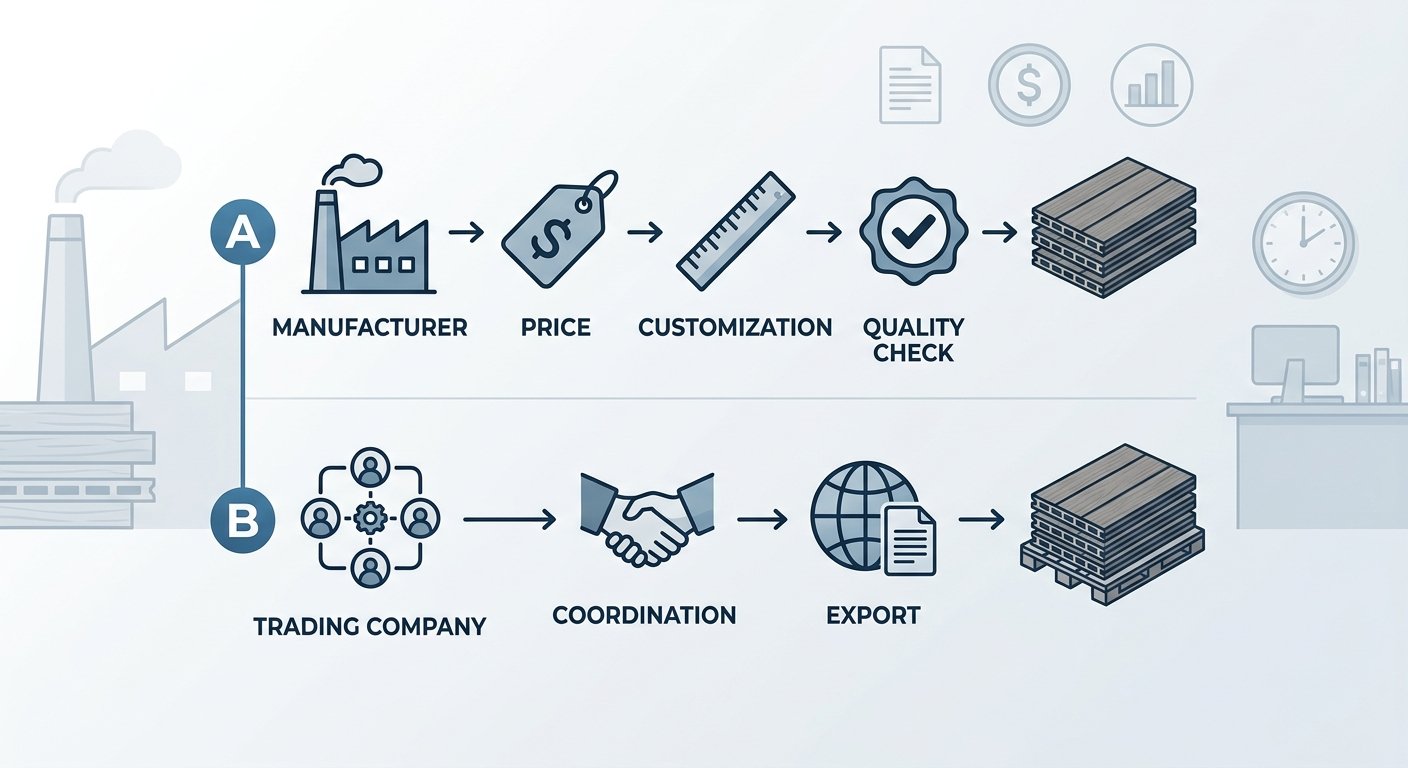
Manufacturers are often better positioned to coordinate product customization because they control or directly manage production. Depending on their equipment and capabilities, they may support customized dimensions, colors, surface textures, embossing, packaging, and private-label requirements.
Trading companies can also arrange customized products through their factory partners. Their effectiveness depends on how well they communicate technical specifications and supervise production.
For customized WPC wall panels, buyers should confirm:
- Available panel widths, lengths, and thicknesses
- Color and surface-finish options
- Mold or tooling requirements and costs
- Minimum order quantities for customized designs
- Sample approval procedures
- Packaging and private-label capabilities
For repeat bulk orders, direct coordination with the production team can help reduce specification misunderstandings and make future orders easier to manage.
5. Quality Control and Product Consistency
Quality control is critical when purchasing WPC wall panels for commercial projects or wholesale distribution. Differences in dimensions, color, surface finish, density, and packaging can create installation problems or customer complaints.
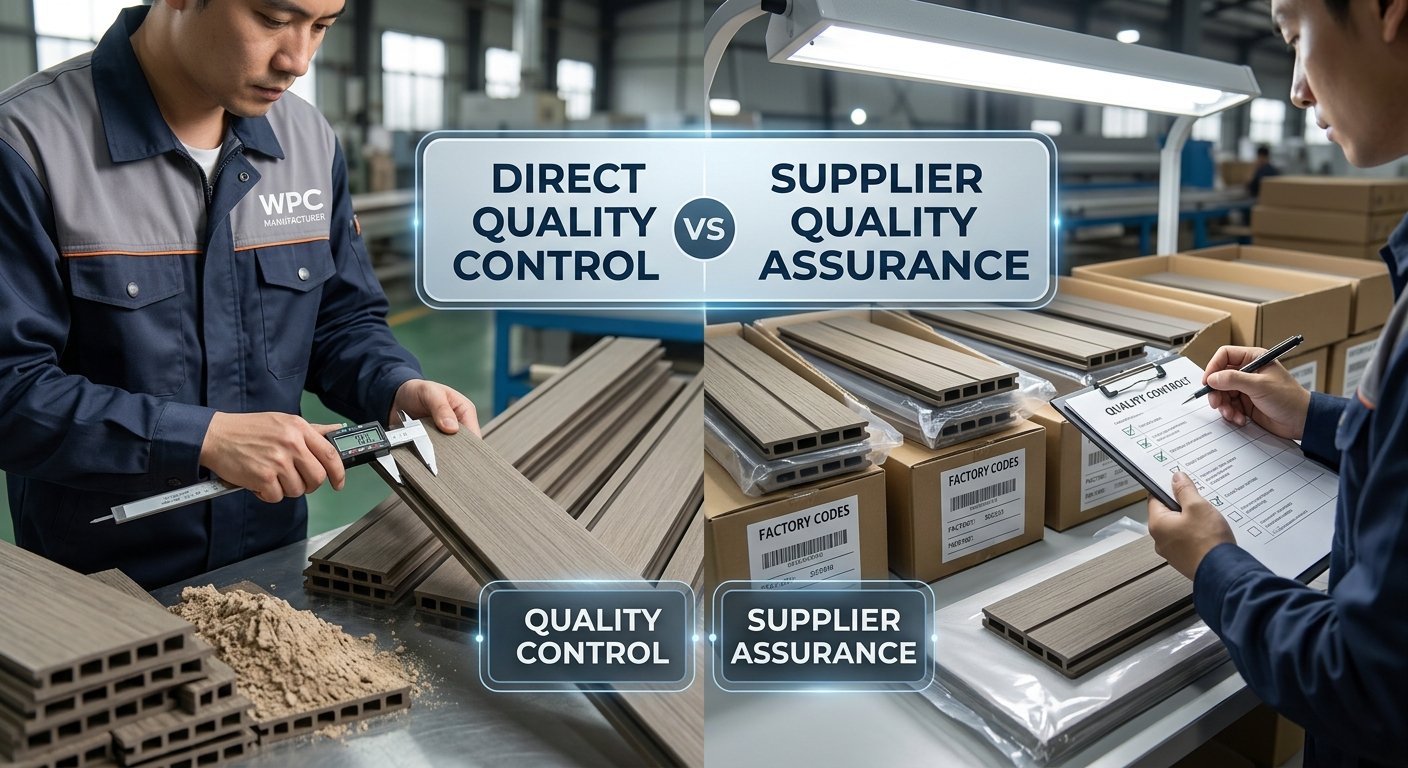
A manufacturer may provide direct access to production inspections, raw-material controls, and finished-product testing. However, buyers should not assume that every factory has a comprehensive quality-management system.
A trading company may use third-party inspections or maintain its own supplier evaluation process. This can be valuable when the buyer needs products from several factories.
Before placing a bulk order, request product samples and written specifications. Confirm dimensional tolerances, appearance standards, packaging requirements, inspection criteria, and procedures for handling defective products.
The key question is not simply whether a supplier is a factory, but whether it can demonstrate consistent quality and accept clearly defined quality responsibilities.
6. MOQ, Lead Time, and Production Capacity
Minimum order quantity (MOQ) and delivery time vary by product design, production schedule, customization requirements, and available inventory.
Manufacturers may require higher quantities for customized colors or special dimensions because production preparation and material purchasing create additional costs. Trading companies may offer more flexible quantities when they have access to existing stock or several suppliers.
For example, a bulk buyer ordering standard WPC wall panels for regular distribution may benefit from a manufacturer’s production planning. A buyer sourcing several decorative building materials in smaller quantities may find a trading company more convenient.
Ask both supplier types to confirm:
- MOQ for standard and customized products
- Current production capacity and available stock
- Sample and mass-production lead times
- Monthly or annual supply capability
- Peak-season scheduling
- Container loading quantity and packing dimensions
Request realistic delivery commitments in writing rather than relying only on verbal estimates.
7. Export Experience and Communication
International procurement involves more than manufacturing. Buyers may need export documentation, shipping coordination, packaging compliance, customs information, and after-sales support.
An experienced trading company may have strong capabilities in these areas, especially when managing multiple product categories. Some manufacturers also maintain dedicated export teams and provide factory-direct communication.
When evaluating suppliers, confirm their experience with your destination market, familiarity with the required shipping terms, response times, and ability to provide accurate technical documentation.
For large orders, clear communication is especially important. Product drawings, approved samples, order specifications, inspection records, and shipping documents should be consistent throughout the transaction.
8. Which Supplier Is Best for Your Business?
The right supplier depends on your purchasing model.
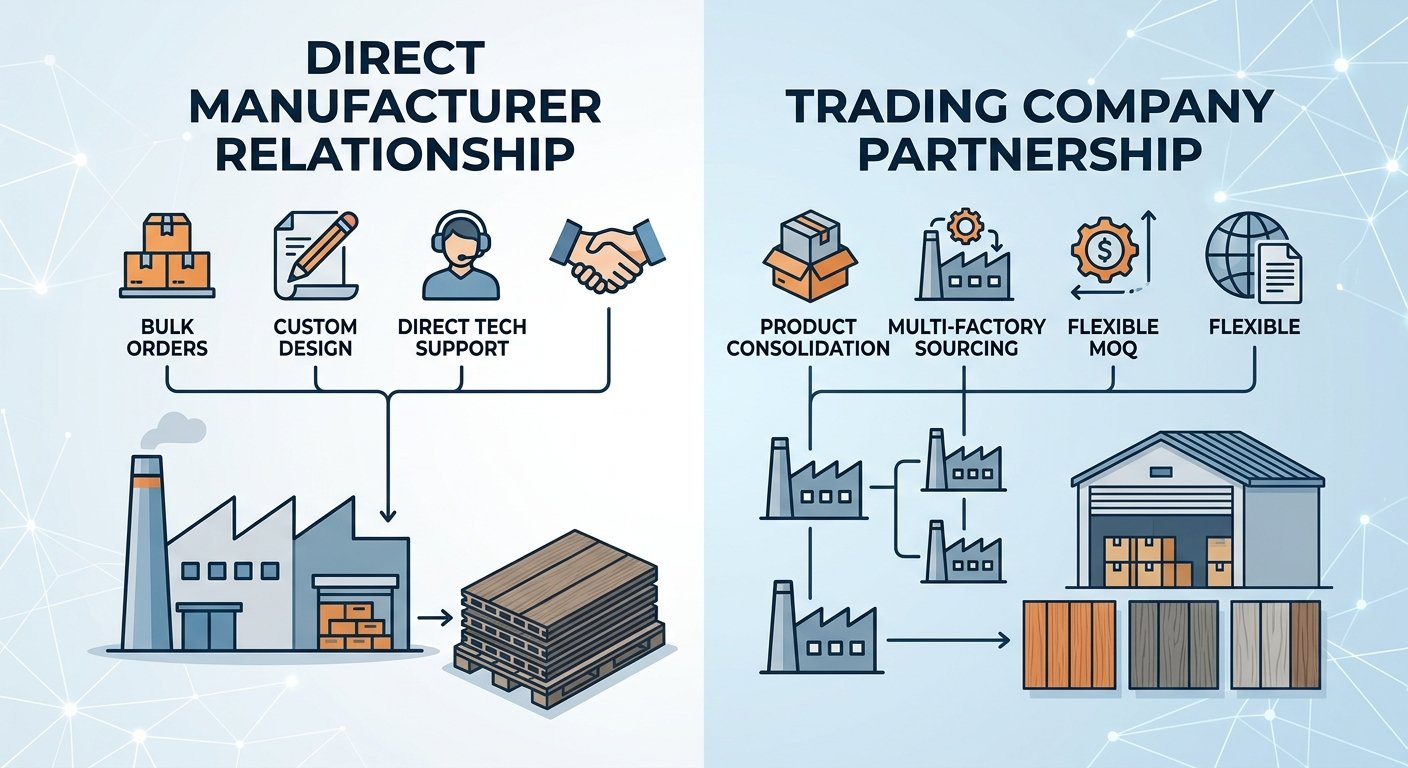
Choose a manufacturer if you:
- Purchase WPC wall panels in bulk or on a recurring schedule
- Need customized colors, dimensions, finishes, or private labels
- Require direct technical communication
- Want to build a long-term production relationship
- Need visibility into manufacturing and quality-control procedures
Choose a trading company if you:
- Need products from several manufacturers
- Want to consolidate different product categories
- Prefer a single contact for sourcing and export coordination
- Need smaller quantities of available standard products
- Lack the resources to coordinate multiple suppliers independently
For distributors and importers with consistent demand, a qualified manufacturer can be a strong long-term partner. For buyers managing complex, multi-product sourcing, a capable trading company may provide greater convenience.
9. How to Verify a Genuine WPC Wall Panel Manufacturer
Before sending a deposit or confirming a large order, conduct basic supplier verification.
- Request the registered company name and business license.
- Ask for the factory address and recent production-line photos or videos.
- Arrange a live video tour or independent factory inspection when appropriate.
- Request samples and technical datasheets.
- Verify production capacity against your expected order volume.
- Confirm payment details match the contracted legal entity.
- Review the sales contract, quality standards, delivery terms, and dispute procedures.
Factory photos alone are not proof of manufacturing capability. Where the order value justifies it, independent inspections and documented quality checks can reduce procurement risk.
Conclusion
Choosing between a WPC wall panel manufacturer and a trading company depends on your procurement priorities. Manufacturers can be attractive for bulk purchasing, customization, and direct production coordination. Trading companies can offer sourcing flexibility, consolidated products, and export-management support.
For importers, distributors, and commercial project buyers, the best approach is to verify supplier capabilities, compare equivalent quotations, inspect samples, and assess total procurement cost.
If your business requires consistent bulk supplies of WPC wall panels, working with a qualified manufacturer can help establish a more direct and scalable supply relationship.

WPC Wall Panel Wholesale Price: B2B Buying Guide
Discover WPC wall panel wholesale prices, key cost factors, bulk order discounts, shipping costs, and tips for sourcing directly from manufacturers.

WPC vs SPC Wall Panels : What’s the Difference?
Compare WPC vs SPC wall panels by materials, structure, waterproofing, durability, installation, cost, and applications to choose the right panel.
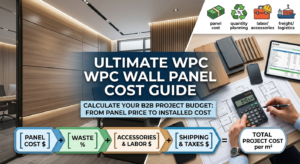
WPC Wall Panel Cost Calculator: Complete Project Cost Guide
Calculate WPC wall panel costs using wall area, panel price, waste, accessories, labor, shipping, and installation expenses.