
What Is WPC Wall Panel Made Of?
WPC wall panels are engineered decorative panels made from Wood Plastic Composite (WPC) materials. They combine wood-based fibers with thermoplastic polymers and selected additives to create a material that offers a wood-like appearance with improved moisture resistance, dimensional stability, and low-maintenance characteristics.
But what exactly is inside a WPC wall panel?
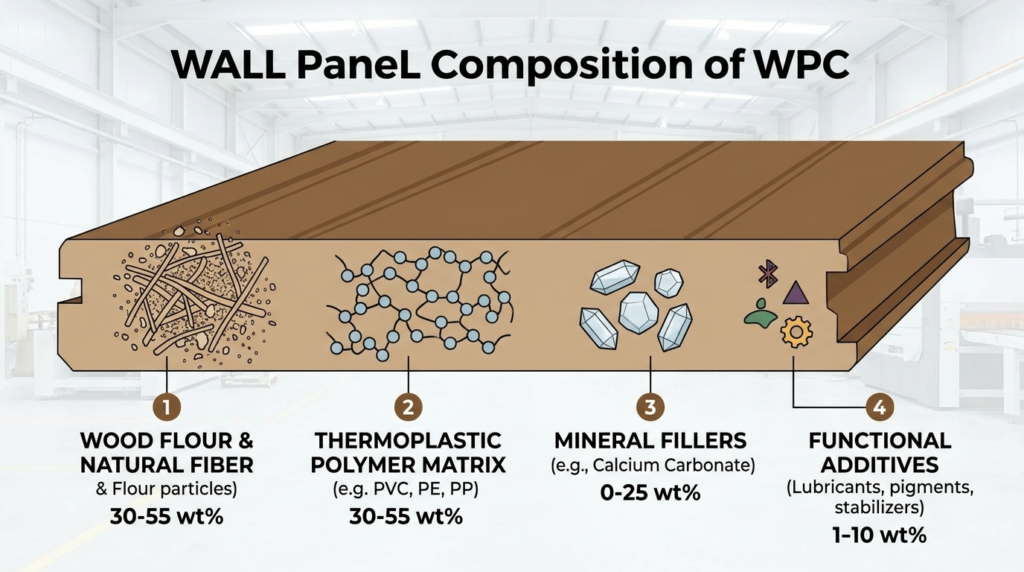
The basic structure normally includes four material groups:
- Wood flour or natural fiber
- Thermoplastic polymer
- Mineral fillers, when required
- Functional additives
The exact formulation varies between manufacturers and applications. Interior decorative WPC wall panels, acoustic panels, exterior profiles, and fire-performance products may use different formulations.
For B2B buyers, understanding the composition is important because the ratio and quality of raw materials directly influence density, weight, strength, surface quality, moisture resistance, dimensional stability, appearance, and production cost.
What Materials Are Used in WPC Wall Panels?
A typical WPC wall panel can be simplified as:
Wood Fiber + Polymer + Additives = Wood Plastic Composite
Some products also include mineral fillers such as calcium carbonate.
| Material | Typical Range* | Main Function |
|---|---|---|
| Wood flour / fiber | 30–55 wt% | Natural fiber, rigidity and texture |
| Thermoplastic polymer | 30–55 wt% | Binding, moisture resistance and processing |
| Mineral filler | 0–25 wt% | Density, stiffness and cost control |
| Additives | 1–10 wt% | Processing, color and performance |
*These are general illustrative ranges rather than universal industry specifications. Actual formulations depend on the manufacturer, polymer system, product structure, and target performance.
1. Wood Flour and Wood Fiber
Wood-based material is one of the defining components of WPC.
Manufacturers may use:
- Wood flour
- Wood fiber
- Hardwood fiber
- Softwood fiber
- Bamboo fiber
- Other lignocellulosic materials
Wood flour is produced by grinding wood into small particles. The particle size, moisture content, and consistency can affect extrusion and final product quality.
The wood component can contribute to:
- Wood-like appearance
- Rigidity
- Surface texture
- Composite reinforcement
- Reduced reliance on solid timber
However, wood naturally absorbs moisture. Therefore, moisture control during raw material preparation is critical.
Excessive moisture can cause bubbles, voids, poor bonding, and surface defects during extrusion.
2. Thermoplastic Polymer
The polymer forms the matrix that surrounds and binds the wood-based material.
Common polymers used in WPC products include:
PVC
PVC is widely used in interior decorative WPC profiles.
It provides:
- Moisture resistance
- Extrusion processability
- Dimensional stability
- Compatibility with decorative surface treatments
PE
Polyethylene is commonly associated with outdoor WPC products but can also be used in specific composite profiles.
PE provides:
- Moisture resistance
- Chemical resistance
- Good processing characteristics
PP
Polypropylene is another polymer used in WPC formulations.
It can provide:
- High stiffness
- Good dimensional stability
- Low moisture absorption
- Suitable processing characteristics
The best polymer depends on the product’s application and manufacturing technology. There is no single polymer that is universally suitable for every WPC wall panel.
PVC vs. PE vs. PP in WPC
| Property | PVC-Based WPC | PE-Based WPC | PP-Based WPC |
| Typical processing | Extrusion | Extrusion | Extrusion |
| Moisture resistance | High | High | High |
| Common applications | Interior profiles | Outdoor/composite products | Interior & exterior profiles |
| Surface finishing | Suitable | Formulation-dependent | Formulation-dependent |
| Thermal characteristics | Formulation-dependent | Formulation-dependent | Generally higher processing temperature |
The polymer type should always be confirmed in the manufacturer’s technical documentation.
3. Mineral Fillers
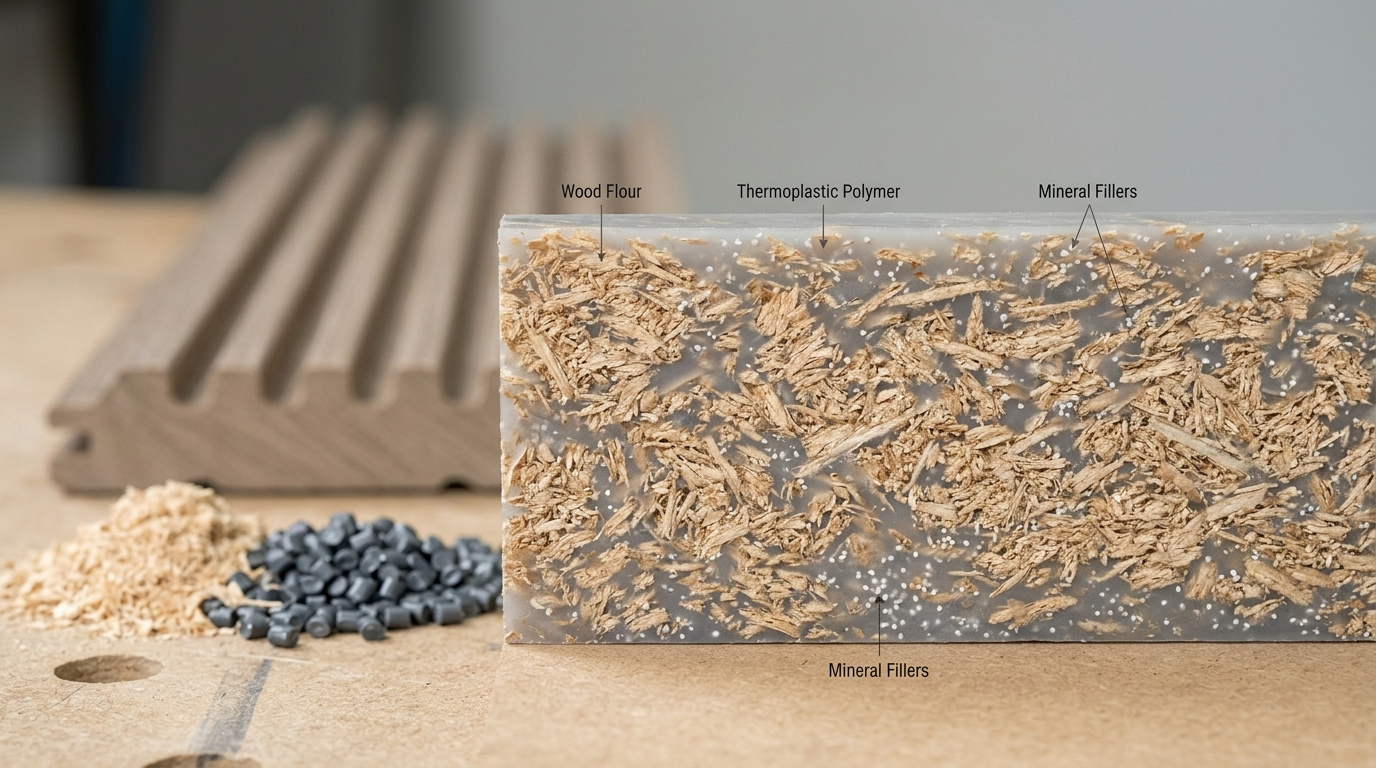
Some WPC formulations contain mineral fillers such as calcium carbonate (CaCO₃).
Mineral fillers can be used to modify:
- Density
- Stiffness
- Processing behavior
- Dimensional properties
- Material cost
However, adding more filler does not automatically improve product quality.
A formulation with excessive filler can affect:
- Impact resistance
- Weight
- Flexibility
- Surface quality
- Screw retention
Therefore, buyers should evaluate the finished product’s performance, rather than focusing only on filler content.
4. Functional Additives
Although additives normally represent a smaller percentage of the formulation, they can have a significant influence on manufacturing and performance.
Common additives include:
Coupling Agents
Wood fibers and polymers have different chemical characteristics. Coupling agents can improve compatibility and interfacial bonding between the two phases.
Lubricants
Lubricants help control friction and material flow during extrusion.
They can influence:
- Surface quality
- Extrusion stability
- Die release
- Production efficiency
Pigments
Pigments provide colors such as:
- Walnut
- Oak
- Teak
- Gray
- Black
- White
- Natural wood colors
UV Stabilizers
UV stabilizers help reduce degradation caused by ultraviolet exposure, particularly for products used in areas with significant sunlight.
Flame-Retardant Additives
Some commercial products use flame-retardant systems to improve fire-test performance.
However, simply adding a flame retardant does not mean the finished panel automatically meets a specific fire classification. The complete product must be tested according to the applicable standard.
WPC Wall Panel Composition: Does the Ratio Matter?
Yes.
The ratio between wood, polymer, filler, and additives affects the final characteristics of the product.
For example:
| Component | Example A | Example B |
| Wood-based material | 40 wt% | 50 wt% |
| Polymer | 45 wt% | 35 wt% |
| Mineral filler | 10 wt% | 10 wt% |
| Additives | 5 wt% | 5 wt% |
| Total | 100 wt% | 100 wt% |
These two formulations may have different:
- Density
- Moisture behavior
- Surface characteristics
- Stiffness
- Processing requirements
- Weight
A higher wood ratio does not automatically mean better quality. Similarly, more polymer does not automatically mean a superior product.
For B2B purchasing, documented finished-product performance is more meaningful than a marketing claim about material ratio alone.
How Are WPC Wall Panels Manufactured?
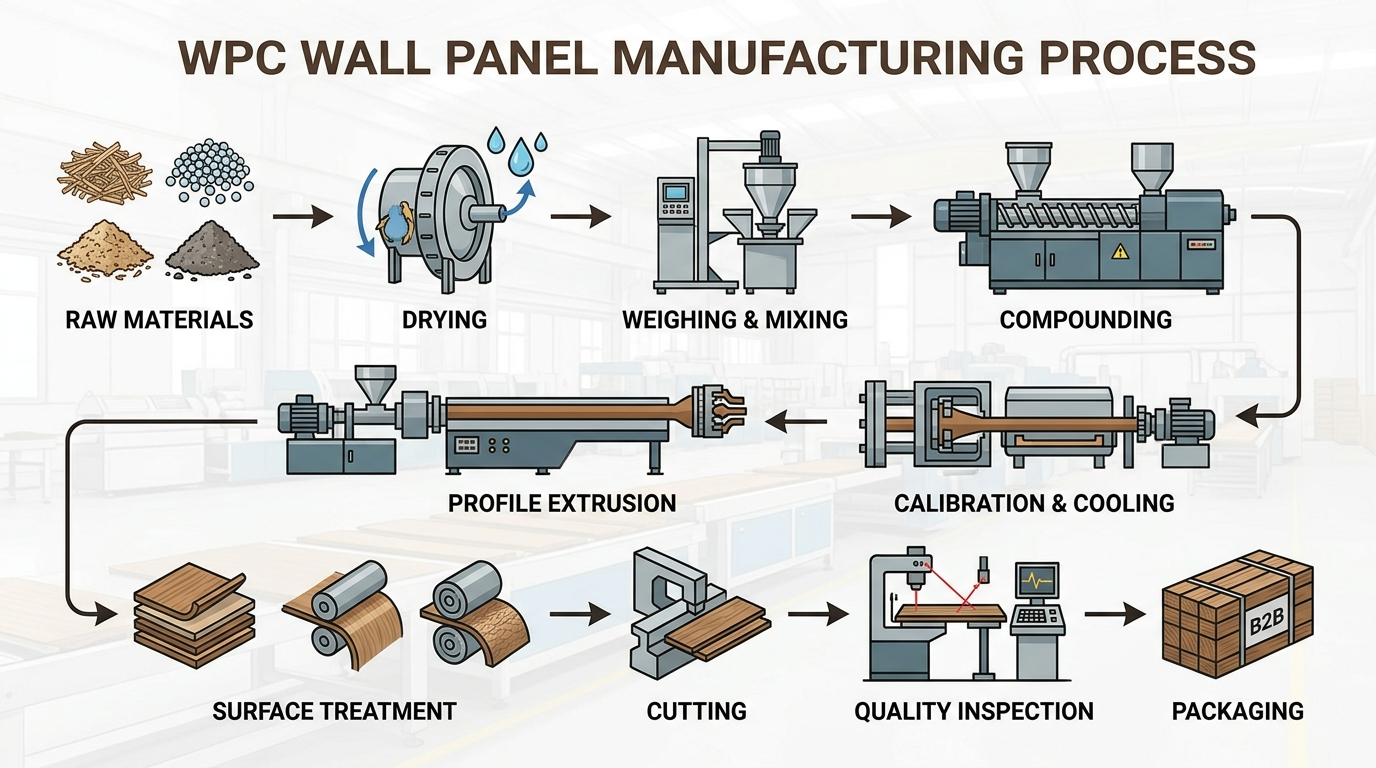
WPC wall panel production normally involves several controlled stages.
Step 1: Raw Material Preparation
Manufacturers prepare wood fiber, polymer, fillers, pigments, stabilizers, lubricants, and other additives.
Raw materials should be controlled for:
- Moisture
- Particle size
- Purity
- Consistency
Step 2: Drying
Wood-based materials are dried before processing.
This is important because excessive moisture can lead to:
- Bubbles
- Voids
- Surface defects
- Poor bonding
- Dimensional problems
Step 3: Weighing and Mixing
Each ingredient is measured according to the production formulation.
Accurate batching helps maintain consistency in:
- Color
- Density
- Weight
- Surface appearance
- Mechanical properties
Step 4: Compounding
The raw materials are mixed under controlled heat and mechanical shear.
During compounding:
- The polymer softens or melts.
- Wood fibers disperse throughout the polymer.
- Additives are distributed.
- A relatively uniform composite material is created.
Twin-screw extrusion technology is commonly used for controlled compounding.
Step 5: Profile Extrusion
The composite is heated and pushed through a specially designed die.
The die determines the profile shape.
This allows manufacturers to produce:
- Fluted wall panels
- Slatted panels
- Flat panels
- Hollow profiles
- Decorative groove panels
- Custom architectural profiles
Step 6: Calibration and Cooling
After leaving the die, the hot profile passes through calibration equipment to maintain accurate dimensions.
The profile is then cooled to stabilize its shape.
Important dimensional parameters include:
- Width
- Thickness
- Length
- Groove dimensions
- Profile geometry
Poor calibration or cooling can result in warping or dimensional variation.
Step 7: Surface Treatment
WPC panels can receive different surface treatments.
Lamination
Decorative films can create realistic wood-grain patterns and different colors.
Embossing
Embossing creates a three-dimensional texture.
Brushing
Brushing can enhance the appearance of natural wood grain.
Printing
Printing technology can create customized decorative patterns.
Co-Extrusion
A protective surface layer can be produced together with the core profile, depending on the product structure.
Step 8: Cutting
The finished profiles are cut into standard or customized lengths.
For wholesale buyers, customized lengths can reduce installation waste but may also increase MOQ or production complexity.
Step 9: Quality Inspection
Professional manufacturers should inspect finished panels before packaging.
Important parameters can include:
| Parameter | Example Measurement |
| Length | mm |
| Width | mm |
| Thickness | mm |
| Weight per meter | kg/m |
| Density | kg/m³ |
| Moisture content | % |
| Water absorption | % |
| Color deviation | ΔE |
| Dimensional variation | mm |
| Fire performance | Applicable test result |
The exact acceptance limits should be agreed upon before mass production.
WPC Wall Panel Manufacturing Flow
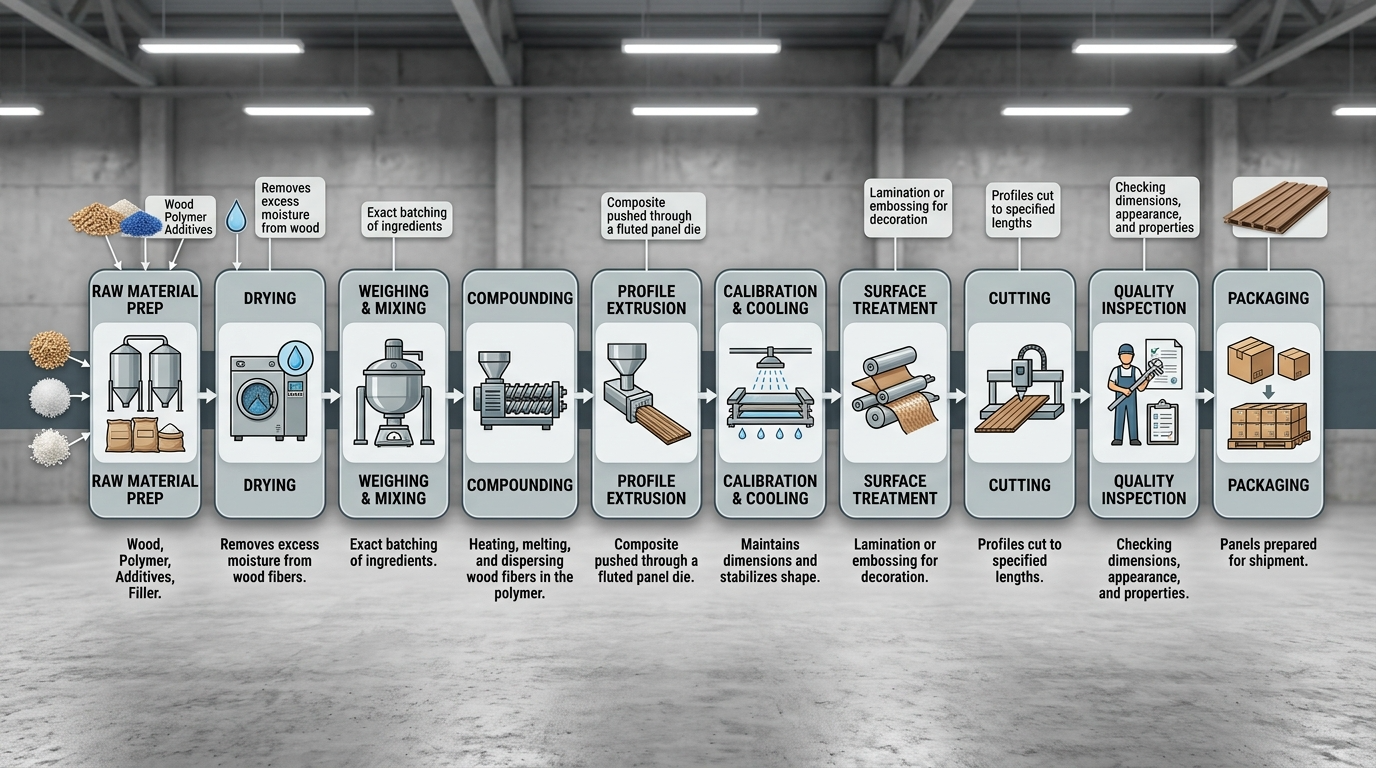
The complete production process can be summarized as:
Raw Materials → Drying → Weighing → Mixing → Compounding → Extrusion → Calibration → Cooling → Surface Treatment → Cutting → Quality Inspection → Packaging
Every stage can affect the final product.
This explains why two WPC wall panels with identical dimensions may have significantly different performance and durability.
What Determines WPC Wall Panel Quality?
For B2B buyers, product quality should be evaluated across several dimensions.
Raw Materials
Check:
- Polymer type
- Wood/fiber type
- Moisture content
- Filler content
- Additive system
Manufacturing
Evaluate:
- Extrusion technology
- Production capacity
- Formulation control
- Dimensional accuracy
- Quality-control procedures
Surface
Check:
- Color consistency
- Texture
- Scratch resistance
- Surface adhesion
- Pattern consistency
Performance
Request documentation for:
- Water absorption
- Dimensional stability
- Fire performance
- VOC emissions
- UV/weathering performance where applicable
Is WPC Wall Panel Waterproof?
WPC wall panels generally have higher moisture resistance than conventional MDF and many untreated wood products.
However, water-resistant material does not automatically mean a completely waterproof wall system.
Water can enter through:
- Joints
- Exposed edges
- Installation gaps
- Damaged surfaces
- Poorly sealed connections
For commercial or high-humidity environments, buyers should evaluate both the panel material and the complete installation system.
Is WPC Wall Panel Environmentally Friendly?
WPC can provide environmental advantages when manufacturers use wood-processing residues, recycled polymers, or other recovered materials.
Potential benefits include:
- Use of wood-processing by-products
- Reduced use of solid timber
- Long service life
- Low maintenance requirements
- Potential recyclability
However, buyers should not assume that every WPC product is environmentally equivalent.
For a more accurate assessment, ask suppliers about:
- Recycled content
- VOC emissions
- Polymer type
- Product recyclability
- Environmental certifications
- Product service life
WPC Wall Panel vs. MDF Wall Panel
| Parameter | WPC Wall Panel | MDF Wall Panel |
| Main material | Wood fiber + polymer | Wood fiber + resin |
| Moisture resistance | Generally higher | Generally lower |
| Manufacturing | Commonly extruded | Commonly pressed and machined |
| Surface options | Lamination, embossing, printing, coating | Paint, veneer, laminate |
| Maintenance | Generally low | Finish-dependent |
| Profile flexibility | High | High |
| Common applications | Decorative walls and commercial interiors | Furniture and interior decoration |
The right choice depends on moisture exposure, fire requirements, design, installation method, and project specifications.
What Should Wholesale Buyers Ask a WPC Manufacturer?
Before placing a bulk order, professional buyers should request:
Product Specifications
- Panel dimensions
- Thickness
- Weight per meter
- Density
- Available colors
- Surface finish
- Installation method
Material Information
- Polymer type
- Wood/fiber type
- Material composition
- Recycled content, if claimed
- Additive system
Testing and Certification
- Water absorption data
- Fire-test reports
- VOC test reports
- UV/weathering data where applicable
- Quality-control documentation
Commercial Information
- MOQ
- Sample availability
- Production lead time
- Packaging specifications
- Container loading quantity
- OEM/customization capability
Conclusion
WPC wall panels are engineered composite products made by combining wood-based fiber, thermoplastic polymer, and functional additives.
The quality of a finished WPC panel depends not only on its raw materials but also on:
Material formulation + moisture control + compounding + extrusion + calibration + surface treatment + quality control
For importers, distributors, contractors, and commercial project buyers, the most reliable way to compare products is to focus on measurable technical specifications rather than marketing claims.
When evaluating a WPC wall panel manufacturer, pay particular attention to:
- Material composition
- Polymer type
- Wood/fiber content
- Density
- Weight per meter
- Dimensional accuracy
- Water absorption
- Surface durability
- Fire-test results
- VOC emissions
- Production capacity
- MOQ
- Packaging
- Quality-control procedures
A properly formulated and professionally manufactured WPC wall panel can provide a practical solution for commercial interiors where decorative appearance, moisture resistance, low maintenance, dimensional consistency, and efficient installation are important purchasing criteria.
WPC vs SPC Wall Panels : What’s the Difference?
Compare WPC vs SPC wall panels by materials, structure, waterproofing, durability, installation, cost, and applications to choose the right panel.
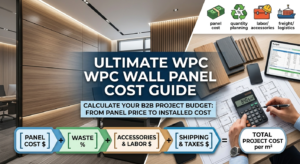
WPC Wall Panel Cost Calculator: Complete Project Cost Guide
Calculate WPC wall panel costs using wall area, panel price, waste, accessories, labor, shipping, and installation expenses.
WPC Wall Panels Wholesale : Complete B2B Buying Guide for Importers & Distributors
Learn how to source WPC wall panels wholesale. Compare specifications, pricing, MOQ, certifications, suppliers, shipping, and B2B purchasing strategies.