
Introduction
The global decorative building materials industry is rapidly shifting toward durable, sustainable, and low-maintenance products. Among these materials, WPC (Wood Plastic Composite) wall panels have become one of the fastest-growing categories in residential and commercial interiors.
For importers, wholesalers, distributors, construction companies, and project contractors, wholesale procurement of WPC wall panels offers significant advantages:
- Lower unit costs
- Stable product quality
- Diverse designs
- Long-term supply capability
- Better profit margins
- Reduced maintenance costs for end users
However, buying WPC wall panels in bulk involves much more than comparing prices. Material composition, fire ratings, moisture resistance, production capacity, certifications, packaging, logistics, and supplier reliability all affect long-term profitability. Buyers who focus only on price often encounter issues such as color inconsistency, deformation, delayed delivery, and customer complaints.
This complete B2B guide explains everything professional buyers need to know before purchasing wholesale WPC wall panels.
What Are WPC Wall Panels?
WPC wall panels are engineered decorative panels made from:
| Component | Typical Ratio |
|---|---|
| Wood Powder / Bamboo Fiber | 30%–40% |
| PVC / PE Polymer | 50%–60% |
| Additives (UV, Fire, Stabilizers) | 5%–10% |
This composite structure combines the natural appearance of wood with the durability of polymer materials. Compared with traditional MDF, plywood, and natural timber, WPC panels offer superior moisture resistance, dimensional stability, and low maintenance.
Why Global Buyers Prefer WPC Wall Panels
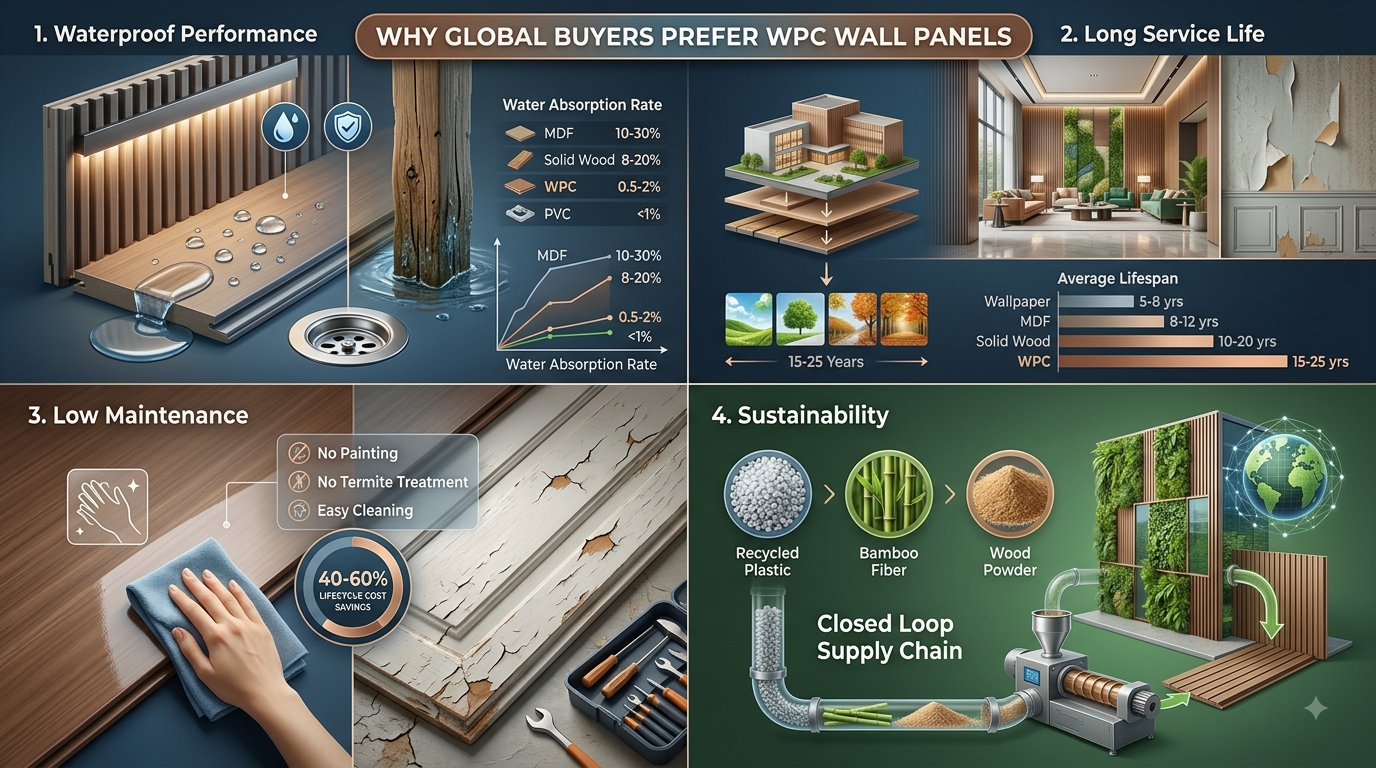
1. Waterproof Performance
Traditional wood absorbs moisture, leading to expansion and deformation.
Typical water absorption:
| Material | Water Absorption Rate |
|---|---|
| Solid Wood | 8–20% |
| MDF | 10–30% |
| PVC Panel | <1% |
| WPC Panel | 0.5–2% |
2. Long Service Life
| Material | Average Lifespan |
|---|---|
| Wallpaper | 5–8 Years |
| MDF Panels | 8–12 Years |
| Solid Wood | 10–20 Years |
| WPC Panels | 15–25 Years |
3. Low Maintenance
WPC panels require:
- No painting
- No anti-termite treatment
- No regular polishing
- Easy cleaning
Maintenance costs can be reduced by 40–60% over the product lifecycle.
4. Sustainability
Many manufacturers use:
- Recycled plastic
- Bamboo fiber
- Recovered wood powder
This reduces environmental impact while supporting green building projects.
Types of Wholesale WPC Wall Panels
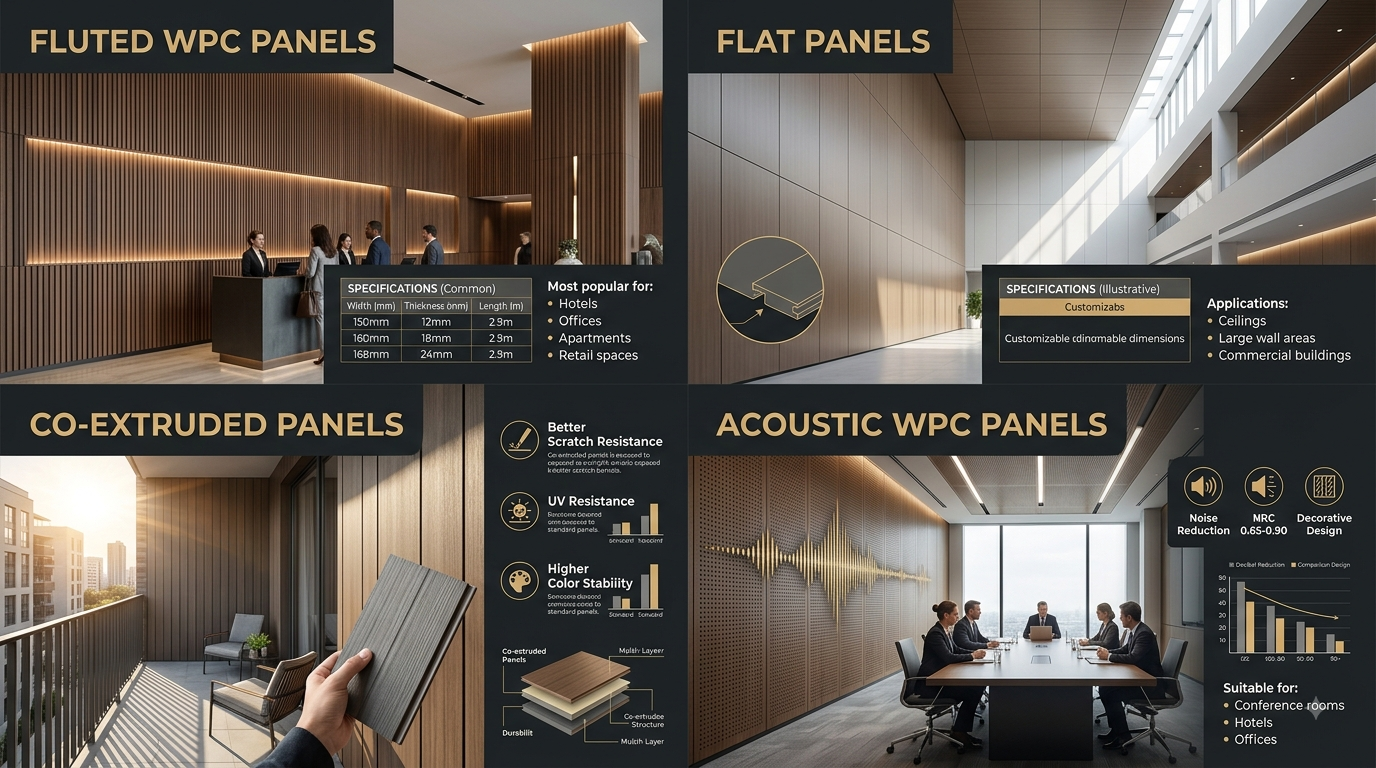
Fluted WPC Panels
Most popular for:
- Hotels
- Offices
- Apartments
- Retail spaces
Common specifications:
| Width | Thickness | Length |
|---|---|---|
| 150mm | 12mm | 2.9m |
| 160mm | 18mm | 2.9m |
| 168mm | 24mm | 2.9m |
Flat Panels
Applications:
- Ceilings
- Large wall areas
- Commercial buildings
Co-Extruded Panels
Advantages:
- Better scratch resistance
- UV resistance
- Higher color stability
Acoustic WPC Panels
Features:
- NRC 0.65–0.90
- Noise reduction
- Decorative design
Suitable for:
- Conference rooms
- Hotels
- Offices
Global Wholesale Market Trends
Growing demand comes from:
| Region | Main Applications |
|---|---|
| North America | Residential Remodeling |
| Europe | Green Building Projects |
| Middle East | Luxury Interiors |
| Southeast Asia | Commercial Projects |
| Australia | Hospitality Industry |
WPC wall panels are increasingly replacing:
- MDF
- Natural wood
- Wallpaper
- Stone veneer
Because buyers seek materials that reduce maintenance while improving aesthetics.
Wholesale Price Reference
Prices vary according to:
- Thickness
- Surface finish
- Fire rating
- Density
- Order quantity
| Product Type | FOB China Price |
|---|---|
| Basic WPC Panel | USD 2–4/m² |
| Fluted Panel | USD 3–6/m² |
| Co-Extruded Panel | USD 5–8/m² |
| Acoustic Panel | USD 8–15/m² |
Accessories typically account for:
- 8–15% of project cost
Shipping accounts for:
- 15–30%
Installation:
- 20–40%
Total project cost should always be calculated instead of panel price only.
MOQ (Minimum Order Quantity)
Most manufacturers require:
| Product Type | MOQ |
|---|---|
| Standard Color | 300–500 m² |
| Customized Color | 1000–3000 m² |
| OEM Packaging | 1000–5000 m² |
Professional buyers should consolidate:
- Colors
- Profiles
- Accessories
To optimize shipping costs.
Technical Specifications Buyers Should Verify
Essential Checklist
| Item | Recommended Value |
|---|---|
| Density | 0.65–0.85 g/cm³ |
| Thickness | 8–24 mm |
| Water Absorption | <2% |
| Fire Rating | B1 / ASTM E84 |
| VOC | E0 / E1 |
| UV Resistance | ΔE < 3 |
| Impact Strength | ≥15 kJ/m² |
Request:
- Technical Data Sheet
- Test Reports
- Certifications
Before bulk purchase.
Certifications to Request
Professional suppliers should provide:
Quality
- ISO 9001
Environmental
- ISO 14001
Fire
- ASTM E84
- EN13501
- B1
Chemical Safety
- SGS
- REACH
- RoHS
Indoor Air
- VOC Reports
Packaging Standards
Proper packaging reduces claims.
Recommended:
- Protective film
- PE foam
- Cartons
- Pallets
- Corner protection
Container loading:
| Container | Capacity |
|---|---|
| 20FT | 2500–3500 m² |
| 40HQ | 5000–7000 m² |
Depends on panel thickness.
Shipping Methods
Sea Freight
Most economical.
Transit:
- Asia–USA: 20–35 Days
- China–Europe: 25–40 Days
- China–Middle East: 15–30 Days
Rail Freight
Suitable for Europe.
Transit:
15–25 Days.
Air Freight
For:
- Samples
- Urgent orders
Common Wholesale Buying Mistakes
Choosing Lowest Price Only
Low prices may indicate:
- Recycled inferior materials
- Thin surfaces
- Weak quality control
Ignoring Fire Standards
Commercial projects require certified products.
No Sample Testing
Always verify:
- Color
- Texture
- Installation
Poor Packaging
Damage rates can exceed:
3–8%.
FAQ
1. What is the ideal MOQ for wholesale WPC wall panel purchases?
MOQ depends on product type, color, and customization level. Standard colors generally require 300–500 square meters, while customized colors, logos, and packaging often require 1000–5000 square meters. Buyers planning long-term distribution should consolidate product selections to reduce production complexity and achieve lower unit prices. Higher order volumes also improve container utilization and logistics efficiency.
2. Are WPC wall panels suitable for commercial projects?
Yes. Modern WPC wall panels are widely used in hotels, offices, shopping malls, restaurants, hospitals, and apartment projects. Commercial-grade products often include fire ratings such as B1 or ASTM E84, low VOC emissions, and excellent moisture resistance. Their lifespan of 15–25 years and low maintenance requirements make them a cost-effective solution for large-scale projects.
3. How do I identify a reliable WPC wall panel manufacturer?
Professional manufacturers should provide factory audit support, certifications, test reports, stable production capacity, export experience, and consistent quality control systems. Buyers should request samples, inspect packaging methods, review production facilities, and verify annual output capacity. Long-term supplier reliability is more important than obtaining the lowest initial price.
4. What certifications are important for imported WPC panels?
Buyers should request ISO 9001, ISO 14001, SGS reports, fire test certifications, VOC reports, and chemical compliance documents such as REACH or RoHS. Commercial projects in Europe and North America often require specific fire and environmental standards. Complete documentation reduces import risks and improves customer confidence.
5. Is sourcing directly from factories better than buying from traders?
Direct factory purchasing usually offers lower prices, better customization, and stronger technical support. However, experienced trading companies can simplify communication, logistics, and mixed product sourcing. The best choice depends on order volume, purchasing experience, and supply chain management capabilities. Large importers often prefer direct factory relationships for long-term cooperation.
Conclusion
Wholesale WPC wall panel purchasing is not simply about obtaining the lowest price. Successful importers focus on product specifications, certifications, supplier capability, logistics, packaging, and long-term quality consistency.
Professional buyers who build partnerships with reliable manufacturers gain:
- Stable supply
- Better margins
- Lower risks
- Stronger market competitiveness
As global demand for sustainable decorative materials continues to increase, WPC wall panels remain one of the most attractive categories for distributors, contractors, and commercial project buyers worldwide.
WPC or PVC Wall Panel Which Is Better for Kitchen? Complete Comparison Guide
WPC or PVC wall panel which is better for kitchen? Compare waterproof performance, heat resistance, durability, maintenance, lifespan, cost, and safety to choose the right kitchen wall panel.
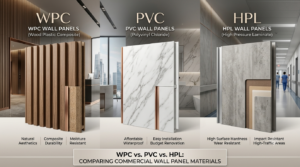
WPC vs. PVC vs. HPL Wall Panels : Complete Material Comparison Guide 2026
Compare WPC, PVC, and HPL wall panels based on material composition, lifespan, density, water resistance, fire performance, maintenance, cost, and commercial applications. Find the best wall panel solution for your project.
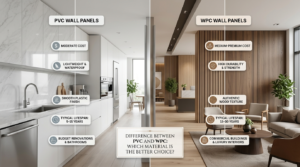
Difference Between PVC and WPC : Which Wall Panel Material Is Better?
Learn the key differences between PVC and WPC wall panels. Compare composition, durability, waterproof performance, fire resistance, installation, maintenance, cost, sustainability, and best applications in this comprehensive guide.