
TL;DR
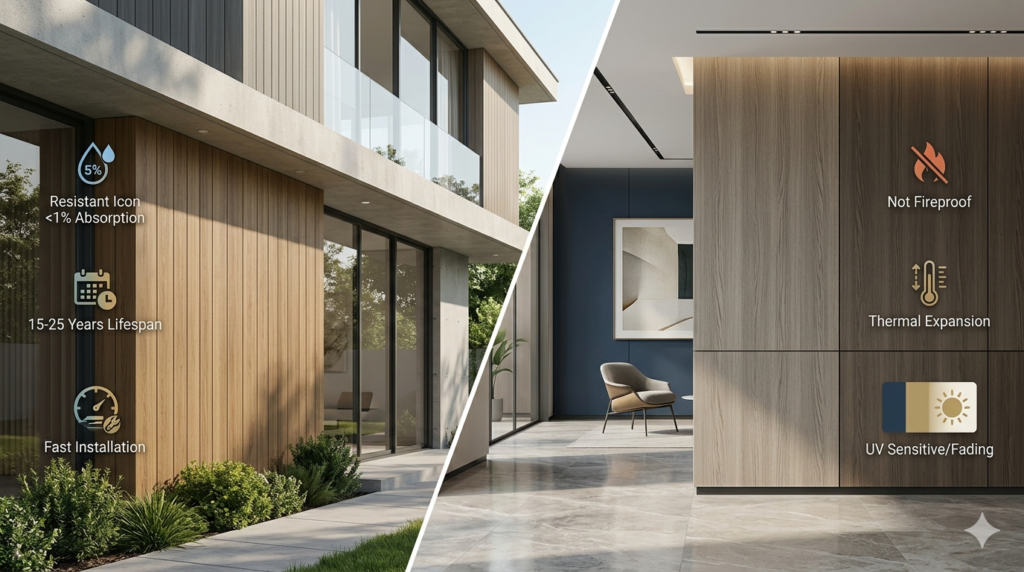
WPC (Wood Plastic Composite) wall panels offer strong moisture resistance (<1% water absorption), low maintenance, and easy installation, making them suitable for residential and commercial applications. Their lifespan typically ranges from 15–25 years. However, they are not fully fireproof, may experience thermal expansion (2–3 mm/m), and have lower structural strength than metal or stone. Choosing WPC depends on balancing cost, performance, and environmental conditions.
What are WPC wall panels?
WPC wall panels are engineered composite materials made from wood fibers (typically 50–70%) combined with thermoplastics such as polyethylene (PE), polypropylene (PP), or PVC. This composition creates a semi-rigid, moisture-resistant material.
WPC wall panels refer to cladding systems designed for both decorative and protective purposes. According to industry data, their water absorption rate is typically below 1%, significantly lower than natural wood.
They are widely used in residential, hospitality, and commercial environments due to their balance of aesthetics and performance.
Why are WPC wall panels widely used in construction?
WPC panels have gained popularity due to their ability to combine the visual appeal of wood with the durability of plastic materials.
Key Adoption Drivers
- Low Maintenance Requirements
- Resistance to Moisture and Insects
- Faster Installation Compared to Traditional Materials
- Consistent Appearance Across Large Areas
- Cost Efficiency in Mid-Range Projects
According to market data, the global WPC market is growing at 10–12% annually, driven by demand for sustainable and low-maintenance materials.
What are the main advantages of WPC wall panels?
1. Moisture Resistance and Dimensional Stability
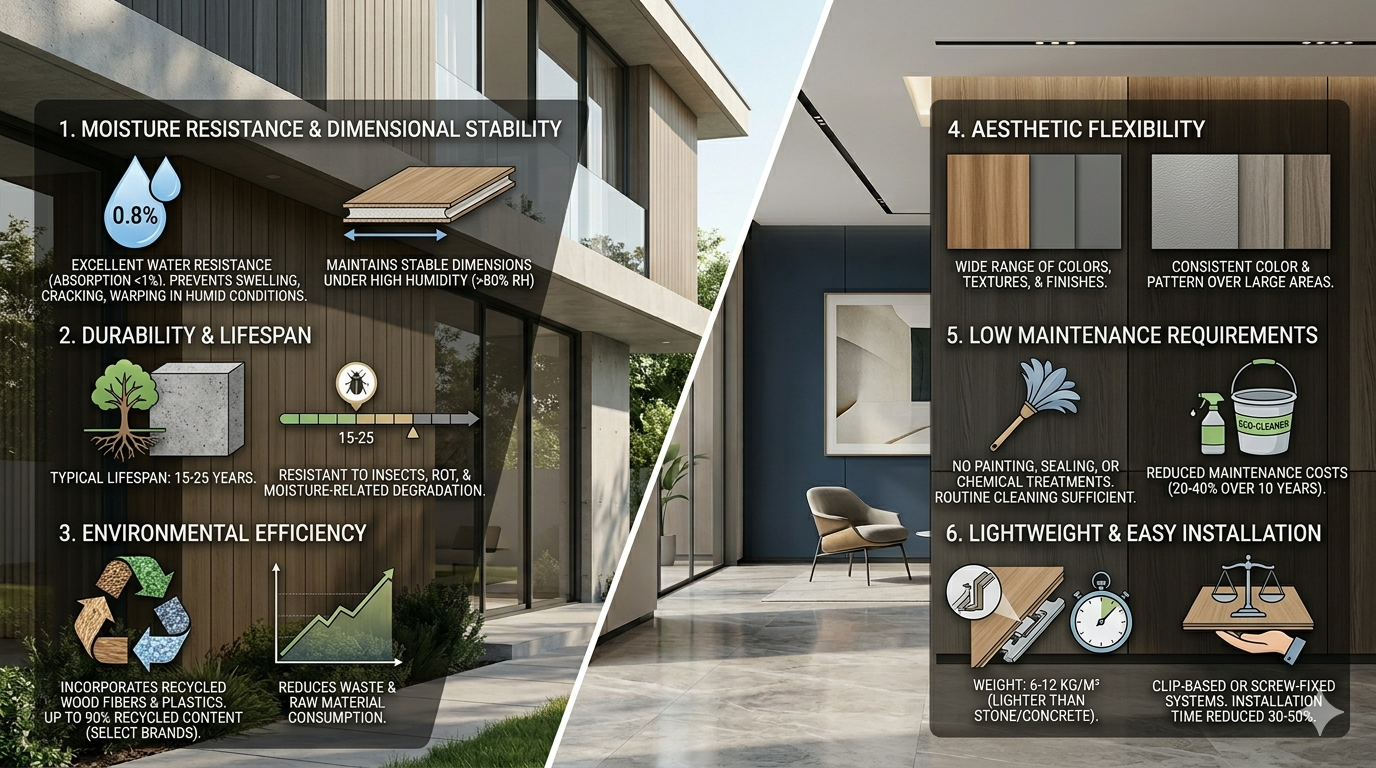
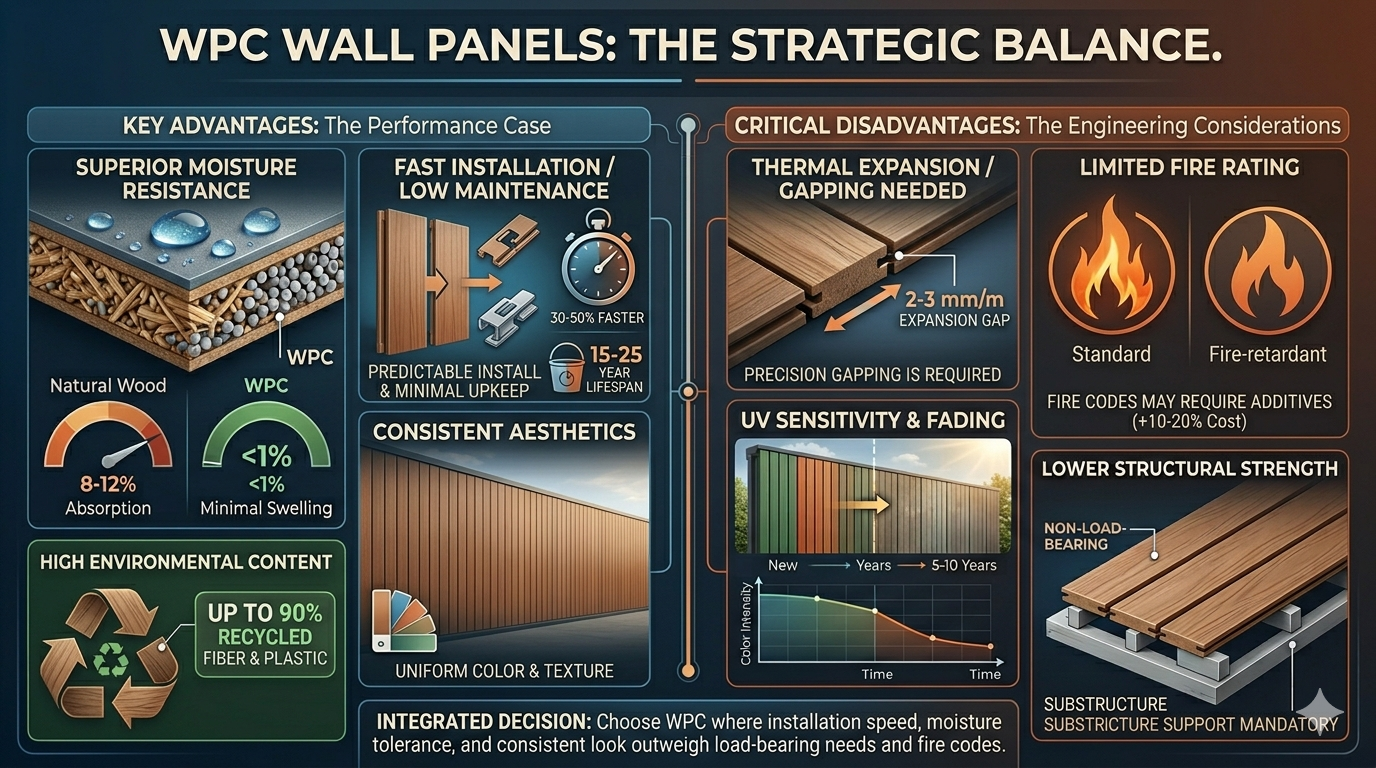
WPC panels offer excellent resistance to water, with absorption rates typically below 1%. This prevents swelling, cracking, and warping in humid environments.
Compared to natural wood, which absorbs 8–12% water, WPC panels maintain stable dimensions even under humidity levels exceeding 80%.
2. Low Maintenance Requirements
WPC panels do not require painting, sealing, or chemical treatments. Routine cleaning with water and mild detergent is sufficient.
Maintenance costs can be reduced by 20–40% compared to traditional wood or stone materials over a 10-year period.
3. Durability and Lifespan
WPC panels typically last 15–25 years depending on environmental conditions and installation quality.
They are resistant to insects, rot, and moisture-related degradation, which contributes to consistent long-term performance.
4. Lightweight and Easy Installation
WPC panels weigh approximately 6–12 kg/m², significantly lighter than stone or concrete panels.
Installation time can be reduced by 30–50%, using clip-based or screw-fixed systems, which lowers labor costs and project timelines.
5. Aesthetic Flexibility
WPC panels are manufactured in a wide range of colors, textures, and finishes, including wood grain, matte, and embossed designs.
Unlike natural wood, they offer consistent color and pattern across large surfaces, which is critical in commercial projects.
6. Environmental Efficiency
WPC panels often incorporate recycled wood fibers and plastics, reducing waste and raw material consumption.
Studies show that up to 90% of WPC material content can come from recycled sources, depending on manufacturer practices.
What are the disadvantages of WPC wall panels?
1. Limited Fire Resistance
Standard WPC panels are not fully fireproof and may not meet strict fire safety regulations for high-rise buildings.
Fire-retardant formulations are available but may increase costs by 10–20%.
2. Thermal Expansion
WPC panels expand and contract with temperature changes at a rate of approximately 2–3 mm per meter.
Improper installation without expansion gaps can lead to deformation or buckling over time.
3. Lower Structural Strength
WPC panels are non-load-bearing materials with moderate mechanical strength.
They are not suitable for structural applications and must be supported by substructures in facade systems.
4. UV Sensitivity and Color Fading
Prolonged exposure to sunlight can cause gradual color fading, typically noticeable after 5–10 years.
UV-stabilized panels reduce fading by 30–50%, but do not eliminate it entirely.
5. Surface Temperature in Direct Sunlight
Dark-colored WPC panels can reach high surface temperatures under direct sunlight, sometimes exceeding 60°C.
This may affect comfort and performance in certain applications.
6. Limited High-End Perception
Compared to natural stone or metal, WPC panels may be perceived as less premium in high-end architectural projects.
This can influence material selection in luxury developments.
Comparison Table: Advantages vs Disadvantages
| Category | Advantages | Disadvantages |
|---|---|---|
| Moisture | <1% absorption | Not fully waterproof |
| Maintenance | Low | Requires proper installation |
| Durability | 15–25 years | Shorter than metal/stone |
| Installation | Fast (30–50% quicker) | Needs skilled planning |
| Cost | Lower upfront | Replacement over time |
| Fire Performance | Optional fire-rated | Not inherently fireproof |
| Aesthetic | Consistent finishes | Less natural than wood |
How do WPC panels compare to alternative materials?
WPC vs Wood
- WPC: Moisture-resistant, low maintenance
- Wood: Natural appearance, high maintenance
WPC vs PVC
- WPC: Stronger, more rigid
- PVC: Fully waterproof but less structural
WPC vs Aluminum
- WPC: Better insulation
- Aluminum: Higher durability and fire resistance
WPC vs Stone
- WPC: Lightweight, cost-efficient
- Stone: Premium durability, heavy
What are the typical applications of WPC wall panels?
Interior Applications
- Residential walls
- Office interiors
- Hotel corridors and rooms
- Retail spaces
Exterior Applications
- Building facades (low to mid-rise)
- Balcony walls
- Garden and landscape structures
WPC panels are particularly effective in projects requiring fast installation and low maintenance.
What factors should you consider before choosing WPC panels?
Key Decision Criteria
- Environment
- Humid → Suitable
- Extreme UV → Consider alternatives
- Fire Requirements
- Strict codes → Use fire-rated panels
- Project Duration
- Short–medium term → Ideal
- Long-term (>40 years) → Consider metal/stone
- Budget
- Limited budget → WPC preferred
Expert Insight: When WPC is the optimal material choice
WPC panels are most effective when project priorities include cost control, speed of installation, and reduced maintenance.
They are particularly suitable for:
- Residential developments
- Hospitality interiors
- Renovation projects
However, for high-rise buildings or extreme environments, materials like aluminum or stone may provide better long-term performance.
Industry trends show increasing adoption of WPC due to its predictable lifecycle cost and ease of installation.
WPC vs SPC Wall Panels : What’s the Difference?
Compare WPC vs SPC wall panels by materials, structure, waterproofing, durability, installation, cost, and applications to choose the right panel.
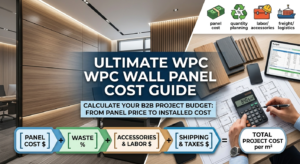
WPC Wall Panel Cost Calculator: Complete Project Cost Guide
Calculate WPC wall panel costs using wall area, panel price, waste, accessories, labor, shipping, and installation expenses.
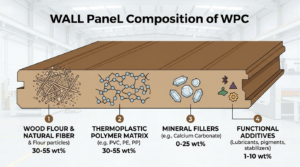
What Is WPC Wall Panel Made Of ? Materials, Composition & Manufacturing
Learn what WPC wall panels are made of, including wood fiber, plastic polymers, additives, material composition, and the complete manufacturing process.