
WPC vs. PVC vs. HPL Wall Panels: Which Wall Panel Material Is Best for Commercial Interiors?
Choosing the right wall panel material is one of the most important decisions in modern interior construction. Commercial projects such as hotels, offices, shopping malls, hospitals, restaurants, and public buildings require wall systems that can provide long-term durability, attractive appearance, safety compliance, and reasonable lifecycle costs.
Among the most commonly selected decorative wall panel materials are:
- WPC Wall Panels (Wood Plastic Composite)
- PVC Wall Panels (Polyvinyl Chloride)
- HPL Wall Panels (High Pressure Laminate)
Although these three materials are frequently compared together, their performance characteristics are significantly different.
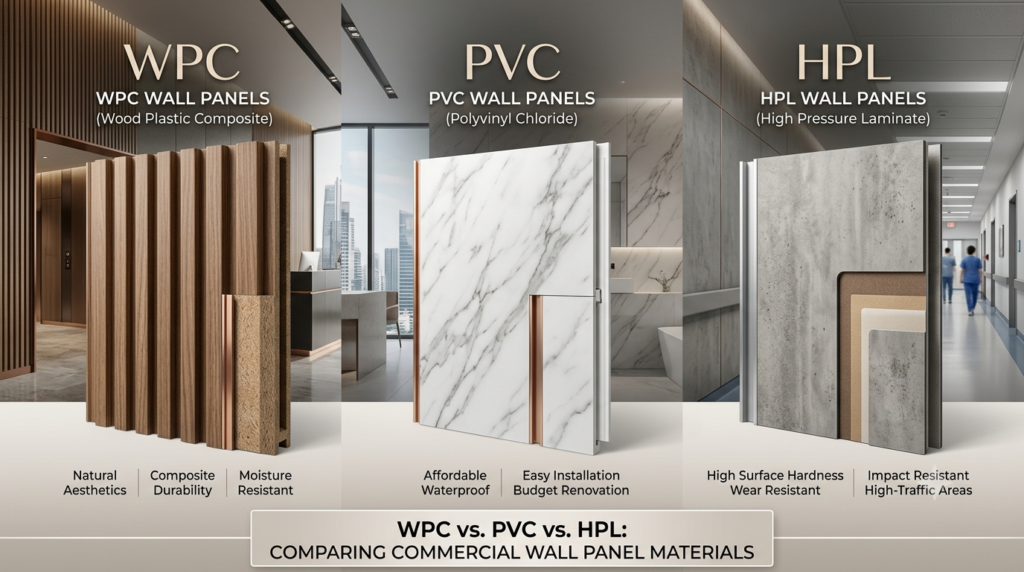
PVC focuses mainly on affordability and waterproof performance.
WPC combines natural aesthetics with composite durability.
HPL delivers extremely high surface hardness and wear resistance for demanding commercial environments.
This guide provides a detailed technical comparison of WPC vs. PVC vs. HPL wall panels, including material composition, physical properties, durability, installation, maintenance, cost, and application recommendations.
1. What Are WPC Wall Panels?
WPC (Wood Plastic Composite) wall panels are engineered decorative panels manufactured by combining wood fibers with thermoplastic polymers.
Typical WPC composition:
| Component | Typical Content |
|---|---|
| Wood fiber / wood flour | 30–60% |
| Polymer resin | 30–60% |
| Additives | 5–15% |
Common additives include:
- UV stabilizers
- Fire retardants
- Coupling agents
- Color pigments
- Anti-microbial additives
The purpose of WPC technology is to combine:
- The visual warmth of natural wood
- The moisture resistance of plastic
- The structural stability of composite materials
2. What Are PVC Wall Panels?
PVC (Polyvinyl Chloride) wall panels are lightweight decorative panels manufactured mainly from plastic polymers.
Typical PVC composition:
| Component | Typical Content |
|---|---|
| PVC resin | 60–80% |
| Plasticizers | 5–20% |
| Stabilizers | 2–10% |
| Pigments and additives | 5–15% |
PVC panels are widely used because they provide:
- Low material cost
- Waterproof performance
- Simple installation
- Easy cleaning
Typical applications include:
- Bathrooms
- Kitchens
- Ceilings
- Budget renovation projects
3. What Are HPL Wall Panels?
HPL (High Pressure Laminate) is a high-density decorative surface material manufactured by compressing kraft paper layers impregnated with thermosetting resin.
Typical HPL structure:
| Layer | Function |
|---|---|
| Protective overlay | Scratch and wear resistance |
| Decorative paper | Visual design |
| Kraft paper layers | Structural strength |
| Resin system | Bonding and hardness |
HPL panels are commonly selected for environments requiring:
- High impact resistance
- High scratch resistance
- Strong surface durability
Applications include:
- Hospitals
- Airports
- Schools
- Commercial buildings
4. WPC vs PVC vs HPL Wall Panels: Technical Data Comparison
The following table compares typical commercial-grade products.
| Technical Parameter | WPC Wall Panels | PVC Wall Panels | HPL Wall Panels |
|---|---|---|---|
| Main Material | Wood fiber + polymer composite | Polyvinyl chloride | Resin impregnated kraft paper laminate |
| Density | 0.65–1.30 g/cm³ | 0.45–0.80 g/cm³ | 1.35–1.50 g/cm³ |
| Thickness Range | 5–30 mm | 5–12 mm | 1–20 mm |
| Expected Lifespan | 15–30 years | 5–15 years | 20–40 years |
| Water Absorption (24h) | 0.5–3% | 0.1–1% | 2–5% |
| Surface Hardness | 2–4H pencil hardness | 1–2H pencil hardness | 4–6H pencil hardness |
| Impact Strength | 5–15 kJ/m² | 2–8 kJ/m² | 15–25 kJ/m² |
| Thermal Expansion | 3–5×10⁻⁵ /℃ | 5–8×10⁻⁵ /℃ | 1–3×10⁻⁵ /℃ |
| Temperature Resistance | -20℃ to 60℃ | -10℃ to 50℃ | -40℃ to 80℃ |
| Maintenance Cycle | 12–24 months | 6–12 months | 12–24 months |
| Installation Difficulty | Medium | Easy | Professional installation recommended |
Actual performance depends on manufacturer formulation, thickness, and certification.
5. Material Strength Comparison
WPC Wall Panels
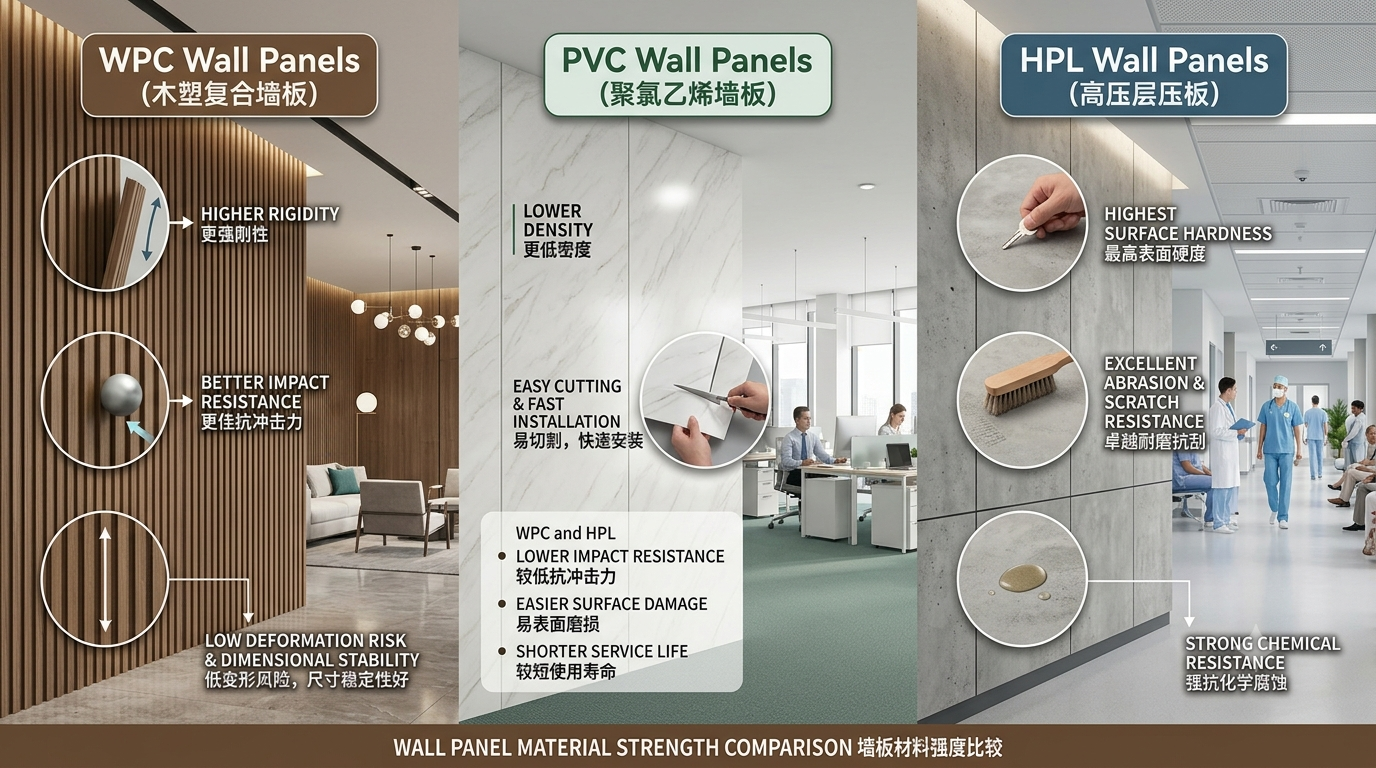
WPC achieves higher mechanical strength than PVC because wood fibers reinforce the polymer structure.
Typical advantages:
- Higher rigidity
- Better impact resistance
- Lower deformation risk
- Better dimensional stability
WPC is suitable for:
- Hotel interiors
- Office walls
- Retail spaces
- Residential feature walls
PVC Wall Panels
PVC has advantages in flexibility and lightweight construction.
Typical characteristics:
- Lower density
- Easy cutting
- Fast installation
However, compared with WPC and HPL:
- Lower impact resistance
- Easier surface damage
- Shorter service life
HPL Wall Panels
HPL provides the highest surface hardness among the three materials.
Advantages:
- Excellent abrasion resistance
- High scratch resistance
- Strong chemical resistance
It is commonly selected for high-traffic public spaces.
6. Lifespan Comparison: WPC vs PVC vs HPL
Service life is one of the most important factors when evaluating wall materials.
| Material | Average Service Life |
|---|---|
| PVC Wall Panels | 5–15 years |
| WPC Wall Panels | 15–30 years |
| HPL Wall Panels | 20–40 years |
Why WPC Lasts Longer Than PVC
WPC has:
- Reinforced wood fiber structure
- Higher mechanical strength
- Better dimensional stability
PVC mainly depends on polymer strength and may become brittle after long-term aging.
Why HPL Has the Longest Lifespan
HPL uses:
- High-pressure compression
- Thermosetting resin structure
- Dense surface layer
This creates excellent resistance against:
- Scratching
- Abrasion
- Impact
7. Waterproof Performance Comparison
Water resistance is important for:
- Hotels
- Bathrooms
- Restaurants
- Coastal buildings
| Water Performance | WPC | PVC | HPL |
|---|---|---|---|
| Water Absorption After 24h | 0.5–3% | 0.1–1% | 2–5% |
| Swelling Risk | <1–3% | <1% | Depends on edge sealing |
| Mold Resistance | Suitable | Suitable | Suitable with proper installation |
| Humid Environment Application | Yes | Yes | Yes |
PVC has the lowest water absorption rate.
However, WPC provides better structural stability when exposed to long-term humidity.
8. Fire Performance Comparison
Fire performance depends on product formulation and certification.
Typical commercial products:
| Fire Standard | WPC | PVC | HPL |
|---|---|---|---|
| GB 8624 | B1 available | B1 available | B1 available |
| EN 13501-1 | B-s1,d0 options available | B-s2,d0 options available | B-s1,d0 options available |
| ASTM E84 | Class A options available | Class B/A options available | Class A options available |
For commercial projects, buyers should always request:
- Fire test reports
- Certification documents
- Technical data sheets
9. Appearance and Design Comparison
WPC Design Advantages
WPC provides:
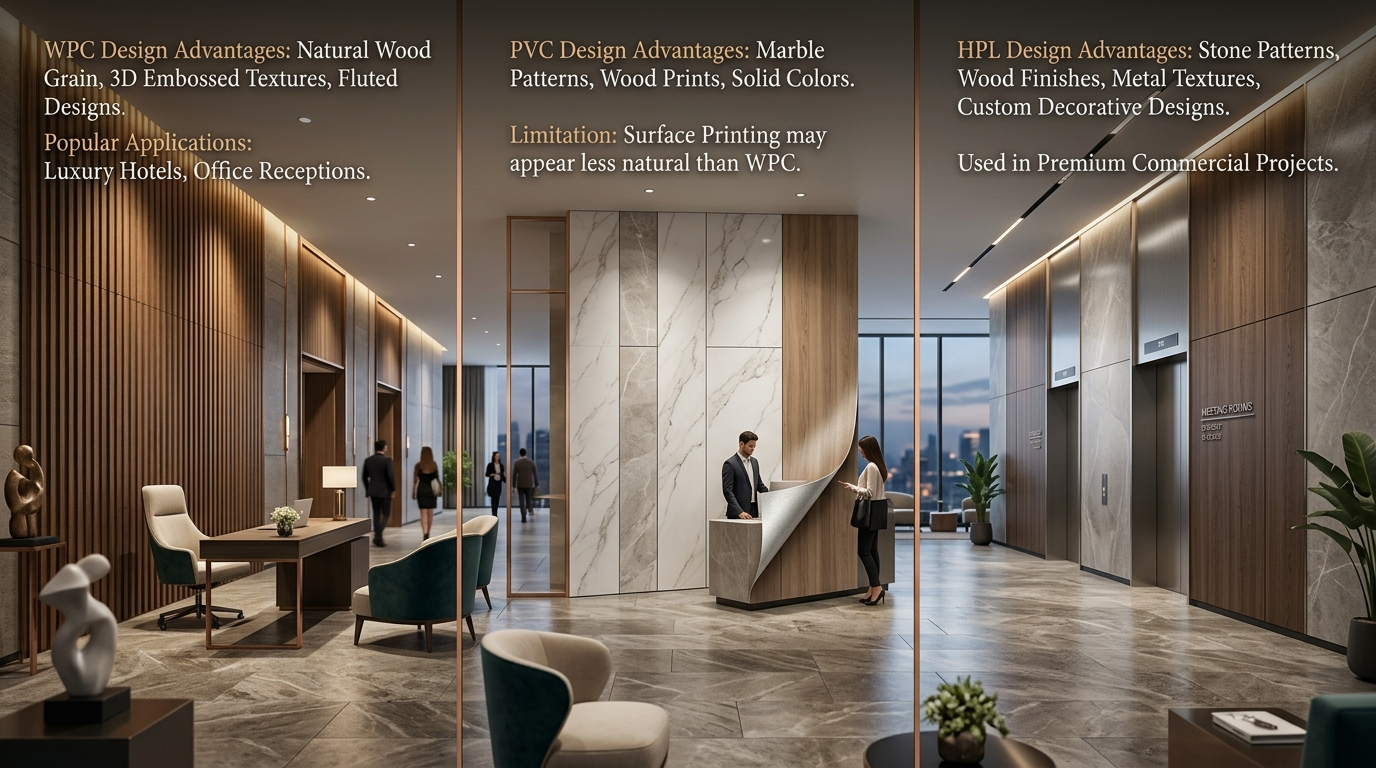
- Natural wood grain
- 3D embossed textures
- Fluted designs
- Modern architectural appearance
Popular applications:
- Luxury hotels
- Office reception walls
- Living spaces
PVC Design Advantages
PVC offers:
- Marble patterns
- Wood prints
- Solid colors
However, many PVC panels rely on surface printing, which may appear less natural compared with WPC.
HPL Design Advantages
HPL offers:
- Stone patterns
- Wood finishes
- Metal textures
- Custom decorative designs
It is widely used in premium commercial projects.
10. Best Applications Comparison
| Application | Recommended Material |
|---|---|
| Luxury Hotel Lobby | WPC / HPL |
| Office Reception Area | WPC |
| Hospital Corridor | HPL |
| Shopping Mall | WPC / HPL |
| Bathroom Wall | PVC / WPC |
| Budget Apartment | PVC |
| Restaurant Interior | WPC |
| Airport/Public Facility | HPL |
Conclusion
The comparison of WPC vs. PVC vs. HPL wall panels shows that each material has a specific market position.
PVC is the economical solution for projects requiring waterproof performance and low initial investment.
WPC provides the best overall balance between:
- Appearance
- Durability
- Sustainability
- Cost efficiency
HPL delivers the highest surface performance for demanding commercial environments.
For modern commercial interiors, WPC wall panels have become one of the most competitive choices because they provide a premium wood-like appearance while maintaining excellent durability and lifecycle value. For architects, distributors, and project buyers, selecting the right material based on technical requirements—not only price—is the key to achieving long-term project success.
WPC vs SPC Wall Panels : What’s the Difference?
Compare WPC vs SPC wall panels by materials, structure, waterproofing, durability, installation, cost, and applications to choose the right panel.
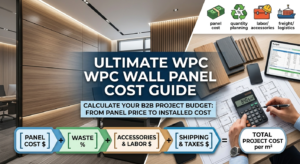
WPC Wall Panel Cost Calculator: Complete Project Cost Guide
Calculate WPC wall panel costs using wall area, panel price, waste, accessories, labor, shipping, and installation expenses.
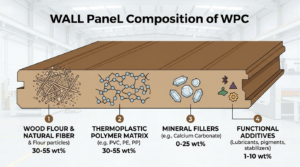
What Is WPC Wall Panel Made Of ? Materials, Composition & Manufacturing
Learn what WPC wall panels are made of, including wood fiber, plastic polymers, additives, material composition, and the complete manufacturing process.